
Return to the Feast - a sermon
Isaiah 55:1-9, Psalm 63:1-8, 1 Cor. 10:1-13, Luke 13:6-9 (It will be helpful to actually read these texts first)
When I was a youngster few things were as wonderful, few things brought me as much joy as a church potluck. It was always a huge spread, and, believe it or not, I loved the salad table. Not that I didn’t love the table with the main dishes with the sweet and sour meatballs and every variation of casserole with cream of mushroom soup. And not that I didn’t love the dessert table with the squares, and the pies, and something that even these conservative rural Mennonites acknowledged was properly called “sex in a pan”. Oh yes, I loved those, but the salad table held a special delight.
The salad table at our potluck dinners usually included a couple versions of 3 bean salad, which I loved, a couple potato salads, which I loved. There might be a coleslaw or two, which I mostly avoided. Of the remaining of the dishes on the salad table, the base ingredient for most of these was Jello. Lovely colorful, glistening, playful, squeeze through your teeth Jello. There were a few “healthier” options of Jello salad with shredded carrots or celery, and some with fruit cocktail, but then you came to the really good ones that included a combination of Jello, Dream Whip, vanilla pudding, and marshmallows. These were salads for the gods. Kale hadn’t even been invented yet. I’m positive in the first 25 years of my life I never tasted a real lime, but I knew what limes tasted like – green Jello.
Eating food is a deeply intimate act. You are taking all sorts of edible (we hope) materials, and ingesting them into our bodies by smelling their odors, seeing their shapes and colors, feeling their texture and heft, and manipulating them past your lips and tongue and teeth, before finally swallowing and handing them over to your digestive system.
Our texts this morning all have to do with food and eating, which rightly fits into our Lenten theme Blessed Hunger, Holy Feast. I will admit when I first saw that theme for Lent I was puzzled. This is lent, when we are supposed to be fasting and doing without not feasting. Feasting seems like a Easter theme, and just like we shouldn’t be singing Christmas carols in October, it doesn’t seem appropriate to discuss feasting in Lent. Perhaps we can discover some Lenten wisdom in these texts.
I will admit that I have a deep fondness for the Old Testament, or the Hebrew Scriptures – especially the prophets, Psalms, and wisdom literature. They are for me a feast of rich words and images. They are often deeply engaged with the physical world and the physical body. In these texts, encounters with God often have physical manifestations that interact with bodies.
And so, looking at our Old Testament texts, both the Psalmist and Isaiah speak to the reader of rich food and feasts.
Isa 55:2 reads “Listen carefully to me, and eat what is good,
and delight yourselves in rich food.”
My bible tells me that where the translator opted for the words “rich food” the Hebrew text actually reads “fat and fatness.” Rich foods seems like a polite and tame translation of fat and fatness. Inviting guests over for an evening of fat and fatness probably wouldn’t get many RSVPs. This is a feast of dripping juices and greasy fingers.
“5 My soul is satisfied as with a rich feast,
and my mouth praises you with joyful lips
6 when I think of you on my bed,
and meditate on you in the watches of the night;”
After an extended rich feast, with joyful, and glistening lips, like the Psalmist, where do we all end up but sprawled out on the bed, on the sofa, on the floor, groaning, moaning, and burping out our praise to our glorious God of abundance.
Both the Isaiah and Psalm text begin with the desert experience of being parched and faint from lack of water and food. There are times when we feel a lack of abundance. Withholding food – like sending a misbehaving boy to their room without supper – is a familiar punishment. There will be times when you are in the desert, and times when you should be in the desert, and these can be important and necessary times when you may not be living the most abundant life. But these desert times are to be temporary and transitional. We are to emerge from the desert – parched and hungry, and ready to receive a feast. What God provides in response is not just a cup of water and a slice of bread to merely satisfy immediate bodily needs. God responds with a rich feast.
Let’s move for a moment from these rich feasts to the parable of the fig tree in Luke. I will confess that this is one of those parables where I puzzle over what I am too understand from it. A fig tree isn’t producing figs, the owner doesn’t like that he isn’t getting figs, and the gardener asks the owner to give the tree one more year. Thinking about our previous texts we see that nobody is getting a rich feast from this fig tree. So what do we make of this parable that seems to be more about scarcity of food than abundance? We will return to this.
And then we quickly turn to the 1 Corinthians text which leaves me even more puzzled than the parable.
“3and all ate the same spiritual food, 4and all drank the same spiritual drink. For they drank from the spiritual rock that followed them, and the rock was Christ. 5Nevertheless, God was not pleased with most of them, and they were struck down in the wilderness.”
Well, doesn’t that just take the fun out of food. What happened to fat and fatness and glistening lips? I can imagine our Old Testament text readers hearing this line about spiritual food, and spiritual drink and responding with surprise and disapproval “Spiritual?” The OT writers are often much more interested in the pleasures of the body than Paul and the writers of the epistles. The OT write of fat and fatness, and Paul writes of spiritual food. And in the OT the food was a sign of God’s abundant pardon, and in Corinthians the people got the spiritual food, and no abundant pardon. God was not pleased with them and struck many of them down.
Earlier in 1 Cor Paul even writes “’Food will not bring us close to God’ We are no worse off if we do not eat and no better off if we do.” 1 Cor 8:8 I think Isaiah, the Psalmist, and I would beg to differ.
Having looked briefly at these four texts I wondered what is the thread that ties them together? What is the Lent message that these texts bring to us? Is it merely they all talk about food? This has puzzled for quite some time, and it was while making a big pot of soup at the Hermitage this Friday that a thought came to me. These texts are about repentance, and abundance. These are the two basic attitudes, actions, stances that are held up. In these text God’s being, God’s character, God’s definitive action is characterized by abundance. And humanity’s being, humanity’s stance is called to be characterized by repentance.
Repentance might be the most Lenten of activities. I will admit that I’ve become quite fond of the word repent. I know it has a lot of baggage and doesn’t feel like a very welcoming word to a lot of people. The word repent, often conjures up old preachers of revivals or street corners. But I see the call to repent simply as the act and intention of turning around. Turning to face your intention. In our context, to repent is the act of turning from what you are facing to face God.
And what are we to repent of? Mostly idolatry. Idolatry, is another of those words that doesn’t comfortably fit into our vocabulary. But I think a helpful way to think of idolatry as turning your face toward, or setting your focus on anything that is not God.
Isaiah asks that wonderful question “Why spend money for that which is not bread?” This is one of my favorite lines in the bible. Why would I eat that food that has no flavor, no joy, no sustenance, no justice when I could eat food that bursts with juices and justice, with richness and reward.
To do so is idolatry. It is being satisfied with less than our God of abundance.
Living a life that is less than the one God is calling you to is turning your face to the idol of fear and familiarity.
God calls us to turn away from that which does not feed and nourish you. Turn away from dry and tasteless food. Turn away from emptiness. Turn away from a life that is less than the one God is offering to you.
I even when does our Mennonite and Brethren value of thrift and “simple living” get in the way of celebrating and participating in God’s abundance? When does our desire for simplicity, frugality and thrift take our eyes off of the God of abundance? The God who offers a rich feast.
And while our stance is to be a stance of repentance, of turning to God, God’s stance, God’s being is one of unending abundance. God doesn’t need to repent. God is already and always facing us. God is the one who provides rich feasts. God is the one who provides spiritual food and water. God is the one who serves up the fat and fatness that leaves us full and beyond satisfied. God is the self-giving one who takes the form of a human so that all may live.
And so, with this lens of repentance and abundance let’s take another look at our texts.
In the Isaiah text we saw the joy of a rich feast, but that is not the end of God’s abundance. God offers us feast for the body and spirit.
“let them [the wicked and unrighteous] return [repent]to the Lord, that he may have mercy on them, and to our God, for God will abundantly pardon.“
God will not just pardon, which would be as sufficient as a cup of water for a thirsty man. But, abundantly pardon, a tall glass of homemade lemonade or a nice strawberry milkshake. That’s what God’s abundant pardon looks like. Turn from your idols of scarcity, fear, and self-dependence, and turn to God who is eager to provide an abundance of pardon and feasts.
And in the Isaiah text once you’ve eaten the feast text God invites you to incline your ear toward God. Once you’ve completed your intimate meal, God invites you to move in closer to hear God speak for God is about to offer a covenant as abundant as the feast that is slowly digesting. God offers not just feasts, but a relationship with the feast provider.
And in Psalm 63 verse 2 we read “So I have looked upon you in the sanctuary, beholding your power and glory.” The psalmist has set his face on, or toward God, has repented or turned toward God. And in verse 7 “for you have been my help, and in the shadow of your wings I sing for joy.” We once again have repentance, abundance, and relationship.
Going back to the parable, my initial understanding of the parable was the tree needed to repent, turn toward becoming the fig tree it was created to be, and the tree owner would feast on figs. But I wasn’t really satisfied with that reading. I realize now that I saw no abundance in the story. But then, thanks to something Naomi said I took a second look, and took note of the gardener’s response. What did the gardener do in response to the demand for repentance, the gardener tilled the soil and offered the tree manure. The gardener provided for the tree and its surrounding ecosystem – a feast of abundant nutrients. We can only imagine that in response the following year the tree produces an abundance of figs, and the tree owner enjoys the abundant feast of figs, and lets hope that that the owner responds in abundance to the gardener.
The parable begins with a strained relationship between the owner and his tree. This relationship can only be resolved through repentance – the man turning away from his impatience, and the tree turning from its not being the tree it was created to be, and both turning toward feasts of abundance.
And this finally brings us back to my quandary about what to do with Paul and this 1 Corinthians text. Like the OT writers, he connects the lack of abundance to idolatry. To an unrepentant people not turning to God. But even then he characterizes the idolaters and eaters and drinkers. So, rich feasts don’t seem to be a sign of God’s abundance to Paul.
Here’s what I can take from Paul. In the Isaiah and Psalm text, the rich feasts were in the context of repentance, intimacy with God, and entering into a covenant with God. What Paul sees is the people of Israel taking the food offered to them by God but the people were not repentant. They were not returning to God. They were ignoring the intimacy and the covenant with God. And if you are just consuming the gift of nourishment without turning to the giver you are just binge eating. In that case, I guess Paul was right to say we are no worse off if we do not eat and no better of if we do. Without a relationship with the great giver, our feasts merely idolize our own gratification. So in Corinthians God remains the God of abundance, but the people lacked the stance of repentance, of turning their face to the source of abundance.
Just to be certain, I am not preaching some kind of culinary prosperity gospel – turn to God and you will eat like royalty (and with no adverse health effects.) God’s abundance is not our prize for repentance. God’s abundance is not conditional. God is abundant. That is simply who God is. A life not turned to God, however, is a life less than we were created for. It is a life lacking in the abundance of God. It is a life lacking the intimate relationship God desires. It is being a fig tree that bears no figs. A life not turned to God leaves us parched and hungry.
So I call you to repent. Turn to God and enjoy God’s abundant feast. And as we receive God’s abundance and enter into intimate relationship with God we in turn become God’s extravagant abundance, God’s rich feast, God’s intimate relationship offered to the whole world.
Amen

"When God Was a Bird" - a review
“When God was a Bird: Christianity, Animism, and the Re-Enchantment of the World” by Mark I. Wallace. New York: Fordham University Press, 2019.
The older I get the less certain I am about language related to God. God is neither this, nor that as well as both this and that. I also have difficulties with God and prepositions: I/we/everything am in/with/through God; God is in/with/through me/us/everything.
And into that blurry language Mark Wallace brings an engaging book with a fascinating premise: God is a bird. The book is his case for a biblically based Christian animism, but it’s his particular emphasis on the avian-God that grabbed my attention. He’s taking some of the bird language in the bible, grabbing hold of it, and running with it. This curious and specific claim of an avian God is why I chose to read this book.
Essentially, this book is Wallace’s argument for a historical biblical animist faith which he feels is needed today as a response to our world’s ongoing ecological crisis. That, and the Holy Spirit is a bird. The format of the book is “an exercise in theology, philosophy, nature writing, and personal anecdote” (x) which provides the reader an nice blending of voices.
Is that through which we encounter God, of God? Is it God? Is venerating something as sacred, the equivalent to calling it God? Is there a real difference between “is God” and “as God”? These questions kept churning in my mind as I read the book. Wallace seemed to be quick to say that encountering God through the natural world tells us that God is the natural world. But while he makes a plea for God is a bird, he also does not claim a pantheistic belief that nature is God. While at times his language about God feels very specific and concrete, he will also make seemingly contradictory statements which tells me that his understanding of God is not simplistic.
Wallace extends God’s incarnation to the animal world. He advocates for “animotheism – the belief that all beings, including nonhuman animals, are imbued with divine presence.” (2) He occasionally extends it to the rest of the natural world, but his interest is primarily animalian. In his trinity the Father represents the otherness of God, Son is the Humanness of God, and the Holy Spirit is the animality of God.
Wallace clearly states what his book is about, or what he is trying to accomplish, “My book’s thesis: Christianity, at its core, is a carnal-minded, fleshly, earthy, animalistic system of belief just insofar as its understanding of the human Jesus (Christology) and the avian Spirit (pneumatology) is rooted in its divinization of human and nonhuman creatures (animality). In this telling of the Christian story as animocentric, God is an animal, without denying the difference between God and animals, because the primary Trinitarian grammar of biblical religion centers on the double enfleshment of God in human and avian modes of being the Son and the Spirit respectively.” (14)
I found his engagement with the biblical text endlessly fascinating, even when I wouldn’t go along with his interpretations. He helped me look at some biblical themes and texts in new ways and for this I am very grateful. Wallace made me stop and reconsider biblical language for God. Is a metaphor such as God brooding over her chicks always just a metaphor, or can it reveal something deeper about God and birds. It may be too easy for us to gloss over the language of “spiritual things” like the Holy Spirit descending as a dove. That being said, I feel like Wallace was very quick to jump from Jesus referenced some animal to Jesus considered it sacred.
I’m not as convinced of a historical biblical animist faith as Wallace is, however, I’m not sure that matters very much; at least to me. The lessons of encountering God in/though/with the natural world and it’s reshaping of our current beliefs, decisions, and activities still resonates.
One thing I try to always be attentive to in reading a book of nonfiction is to be aware of who the author sets up as the enemy. It seems that we often create convenient bogeyman to act as foils against which we can make our claims. (And please note my intentional “we” in the previous sentence. I am as guilty of this as anyone.) Wallace argues against “Central strains of classical Christian opinion” (p. 21) which is admittedly a broad brush. “Classical Christianity” is also filled with voices who take very seriously the place of animals in our spiritual lives.
In the second half of the book he highlights the animist beliefs of Hildegard of Bingen and John Muir as examples of Christianimism. I was surprised that other indigenous and Celtic examples did not figure more prominently. Wallace spends quite a bit of time considering John Muir. While he acknowledges some of the challenges with Muir’s thought, I find the fact that Muir’s ideal wilderness was one where the indigenous people have been removed is more substantially troubling. If the wilderness through which you encounter God is a wilderness that reflects you, as Muir may be guilty of, then have you have potentially created wilderness and God in your own image?
The chapter on Muir also raised concerns for me about historical context. What the natural world meant to civilizations 2000 years ago is very different than what it means to modern, western folk. We are very protected from the vicissitudes of nature. We observe nature as this detached thing over there that only in rare occasions has life or death control over us. Does this protection from the natural world lend itself to our romanticizing or fetishizing the natural world.
Mark Wallace has given his readers a fascinating book. In these kinds of exercises in drawing the boundaries or portraits of God all our definitions fall short. All our descriptions of God are not God. And yet, they are still valuable and teach us of God. Whether one is convinced by Wallace’s biblical interpretation or not is not as urgent is recognizing with Wallace that we encounter God through the natural world and our destruction of the natural world limits our experience of God.
Disclosure of Material Connection: I received this book free from the author and/or publisher through the Speakeasy blogging book review network. I was not required to write a positive review. The opinions I have expressed are my own. I am disclosing this in accordance with the Federal Trade Commission’s 16 CFR, Part 255.

The Hospitality of Silence
(This post initially appeared on the blog for the Hermitage Community.)
Silence is a core practice, a core value, a core gift of The Hermitage. Silence welcomes us no matter our rank or status, no matter our theological or political preferences. Silence enfolds and embraces us no matter our desires or fears. But silence does not force itself upon us. Silence is there to be received, or not. It is ready to engage us in deep attentiveness, or just passing exploration.
The experience of silence draws many people to our retreat center, although not without trepidation for some. Our desire is that the silence of this place will be received as a welcoming space that receives each guest
When we introduce new retreatants to the Hermitage there are two things I try to mention: “We offer each other the gift of silence” and “We practice a gentle silence.”
We recognize that each retreatant is here to do their own work and be attentive to their relationship with God. We honor this by not intruding on their space with noise or conversation.
When I greet guests who seem particularly anxious about the silence I offer the statement about the gentle silence. The silence at the Hermitage is not strident and absolute; it is not to be a source of fear. If you have a question, please ask it. If you have an insight needing to be shared, please share it.
One of our characteristic practices at is eating meals in silence. For people new to silence this particular experience of silence in community causes some people anxiety. Silence alone in your room is one thing, silence at a meal table, with a group of people is shockingly counter-cultural. And yet, once that initial unsettling settles down, the silence of communal meals can also be received as an expression of deep hospitality. In it, we all receive the other guests as they are without social expectations or demands.
Silence welcomes us into a relationship with God free from noisy distractions. And in this silence we are open to turn the ear of our heart to listen to our welcoming God.

I am You: on becoming an American
I am a new American. On November 9 my wife and I traveled to the Gerald R. Ford Museum in Grand Rapids for my citizenship ceremony. People from more than 20 countries became citizens that day.
I grew up in Canada. As a white Canadian I know I’m not the image that comes to mind when most Americans think of immigrants, but I feel as much an immigrant as person coming from a country thousands of miles away.
One quality that many Canadians hold dear is that they are not Americans. Living next door to the world’s political and cultural superpower, it is hard not to feel a little threatened by our neighbors to the south. Former Canadian prime minister Pierre Trudeau once said of the USA “Living next to you is in some ways like sleeping with an elephant. No matter how friendly and even-tempered is the beast, if I can call it that, one is affected by every twitch and grunt.” Canadians spend a lot of energy protecting and reinforcing their Canadian identity from the “twitches and grunts” of this elephant.
When I was a youth one of the ways we did this was by making “American” jokes. This often involved telling stories, typically laced with hyperbole and imagination, of our run-ins with Americans. They often involved scenarios of Americans coming to Canada in July and wondering where the snow was. This also included making fun of American’s comparative ignorance of Canadian geography or politics. We knew much more about the US, than Americans knew about Canada. Our stereotype of Americans was they were fat, stupid, arrogant, and armed, and our stereotype of Canadians is that we were none of those things.
Then I moved to the United States. There is nothing like meeting real people to break apart imagined stereotypes. I have lived in California, Indiana, and Michigan. But for the 25 years that I’ve lived in the U.S. I’ve lived as a non-citizen – first on a student visa, and then, after marrying an American woman, as a permanent resident with a green card. I liked this in but not of, relationship. My language only needed to switch from “those Americans” to “you Americans.” “What is it with You Americans and guns?” “What is it with You Americans and your health care system?” “What is it with You Americans and invading countries?” Sitting on the sidelines and making snide comments may be briefly satisfying, but it is not very constructive or kind.
And now I feel I must no longer stand safely apart. I have finally recognized that this place is my home, and “you Americans” are my family, my neighbors, my coworkers, my people.
This doesn’t mean that I’m not occasionally confused and frustrated by the actions and attitudes of Americans, but no less than I’m occasionally confused and frustrated by my own actions and attitudes. But I am now committed to participate in this country; to get my hands dirty and work to fix the things I think are wrong, and to hold up the ideals that I think makes this country great.
I finally made the choice to become a citizen because I am You.

Why Should I Vote?
A letter to my state representative. (I’ll let you know how he replies, if he replies.)
Greetings Representative Miller,
This past summer my wife and I moved near Three Rivers and into your state district. We have long loved this area and after nearly 20 years in Lansing are glad to call this place home.
After 25 years of living in the US (I am from Canada) I became a citizen in early November. It was an important decision to pursue citizenship, and one I did not, and do not, take lightly.
A representative of the MI Secretary of State’s office was at the citizenship ceremony and I was able to register to vote that same day. Voting is obviously and important privilege, right, and responsibility.
But my question to you is, Why should I vote?
I have lived in Michigan for nearly 20 years and while not able to vote, I do pay close attention to state government. In my time I have seen state representatives redraw district maps in such ways as to disempower voters from the other party which means that even when a majority of the votes are cast for Democratic candidates, a majority of the seats are filled by Republicans.
I have seen state representatives draft voting rules and regulations that make it more difficult to vote.
I have seen state representatives take ballot measures that were supported by the majority of the voter and undermine the will of the electorate by watering down those ballot initiatives so they barely resemble the electorate’s wishes.
I have seen state representatives take steps to remove the powers from elective offices – for the sole reason that someone from the other party was elected to those offices.
Both parties share some blame, but the Michigan Republicans seem to be going overboard with their disregard for the decisions of voters.
So, I ask you, why should I vote? What can you tell me to convince me that my vote will be a participation in true democracy, and not something disregarded by the whim of a party.
Don’t get me wrong, I will vote, but I would love to hear from you why you think I should and how my vote will matter.
Blessings to your and your family this holiday season,
Kevin Driedger

Prayer for an attentive ear
“An attentive ear is the desire of the wise.” (Sirach 3:29)
O deep, listening wisdom,
who am I to desire the desire of the wise?
I ask that you listen to a fool like me,
for I’ve listened enough to know that an attentive ear is not only the desire of the wise,
but also the source of their wisdom.
Give me ears to hear the laments of the broken-hearted.
Give me ears to hear the cries of the displaced.
Give me ears to hear the voices too scared to speak up.
Give me ears to hear the breath of persistent life.
Give me ears to hear the hidden rhythms of the earth.
Give me ears to hear the chorus of the universe.
Give me ears to hear the melody of truth.
Give me ears to hear the resounding echo of your love.
Listening one,
I desire that the ear of my heart be always inclined toward you,
and in the silent space of our mutual listening
wisdom will sing herself into being.
Amen
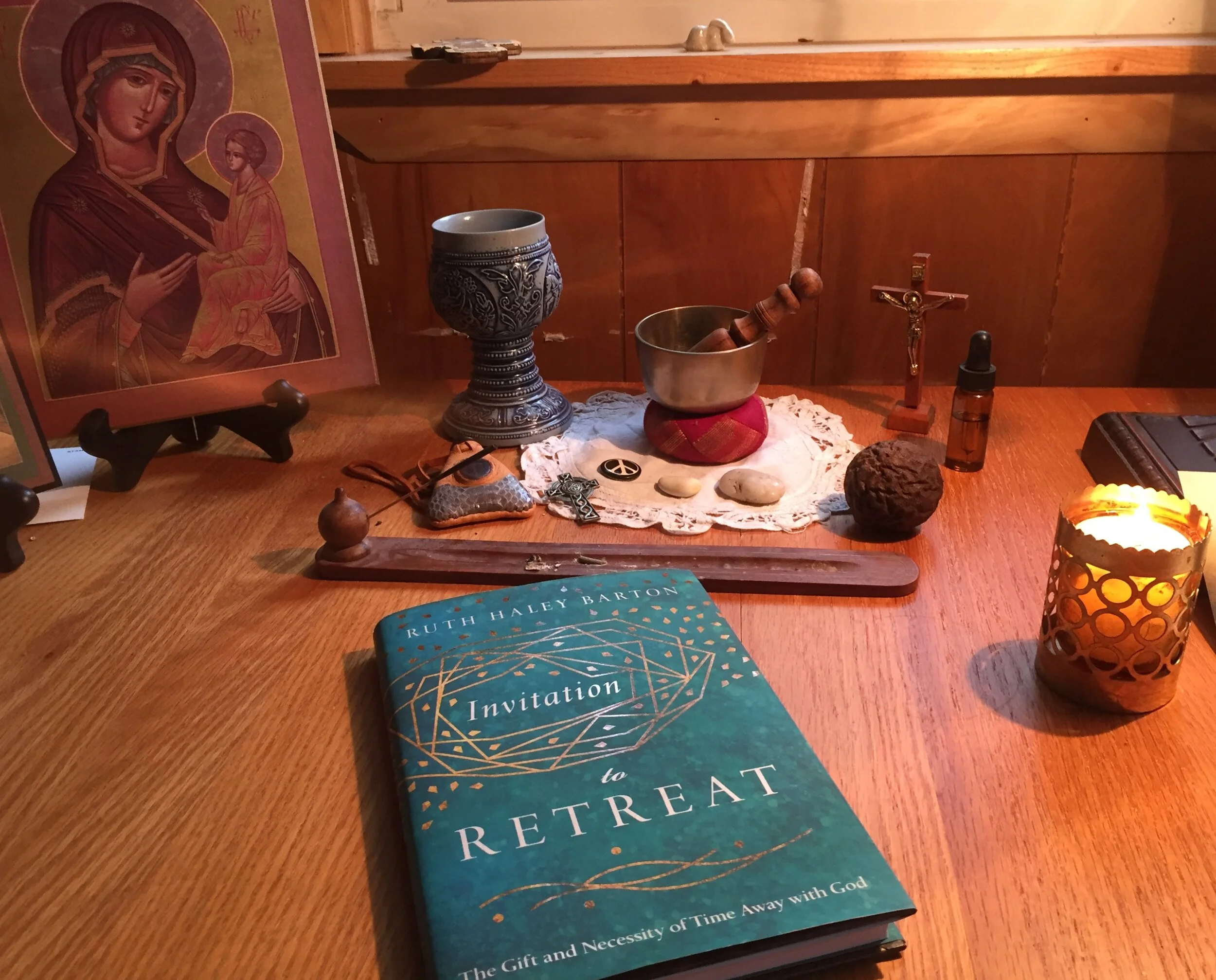
"Invitation to Retreat" by Ruth Haley Barton
Invitation to Retreat: The Gift and Necessity of Time Away with God by Ruth Haley Barton. IVP Books, 2018
Ruth Haley Barton and her work with Transforming Center has built a strong collection of resources aimed at tending to the spiritual lives of pastors and Christian leaders. Her volume “Strengthening the Soul of Your Leadership” published in 2008 with a second edition published in 2018 laid the foundation of much of her following work. Through workshops, retreats, podcasts, and further books Barton has shown that the work of Christian leadership is soul work. Her work follows a similar path to that of Richard Foster in teaching a largely evangelical audience the wisdom ancient spiritual practices have for modern busy leaders.
Her latest book explores the spiritual practice of retreat.
As every Christian book about retreat should do, she grounds her invitation to retreat in the example of Jesus and his own practice of retreating to a quiet place to pray, as well as his calling his disciples come away to a deserted place and rest a while. (Mk 6:30-31) Since that time, people in the church have recognized the importance of balancing their active life of work, with a time of retreat to give deeper attention to their relationship with God. “Retreat in the context of the spiritual life is an extended time apart for the purpose of being with God and giving God our full and undivided attention.” (P. 4)
Retreat often has two phases. The first phase is a retreat away from something. Barton uses the military phrase of strategic withdrawal from those places where we might be in danger. These dangers include distractions, trying too hard, exhaustion, poor boundaries, and feeling as if everything depends on you.
At The Hermitage, a retreat center in southwest Michigan where I am on staff, we will encourage retreatants to begin their time of retreat simply with relaxing and not doing anything. People need time to let go. Sometimes, that is all that can be, or needs to be accomplished on a retreat; simply letting go.
Once you have retreated away from something, the next phase is to retreat into something – and Barton describes that something as the rhythm of your retreat. She takes a few chapters to discuss moving into a different rhythm, one based largely on fixed-hour prayer. She sees fixed hour prayer as an important way to reset one’s mode of being. In an appendix she provides an order of prayer for praying four times a day during one’s retreat.
At the Hermitage we often talk about the rhythms of the Hermitage with daily morning prayer, including Eucharist on Wednesdays and centering prayer on Saturdays. Communal meals eaten in silence also help to live into the rhythm of daily life. These rhythms provide a structure, or a framework upon which the retreatants, and the staff, can shape and guide their day and give space to their intentions.
After the initial getting away to a retreat, Barton acknowledges that the retreatant can move into an experience of a deeper letting go and relinquishing. Letting go of control – you may have planned to read a few books, or write a paper, but on retreat you realize the Spirit is calling you to something completely different. Barton relates that retreatants may also experience a relinquishing of false-selves, and a letting go of identity.
In the next chapters Barton discusses the creative possibilities that can happen on retreat. Retreats can become productive times of discernment, recalibration, and finding spiritual freedom. It is important not to rush to these more productive experiences of retreat too quickly without giving enough time to let go and enter into the rhythm of the retreat.
Her final two chapters discuss the very important topic of returning from retreat. The retreat is not an end in itself. “The purpose of retreat is twofold: to become more deeply grounded in God as the ultimate orienting reality of our lives, and to return to the life God has given us with renewed strength, vitality, and clarity about how we are called to be in God for the world.” (p. 115) It is not uncommon for people to want to remain in the heightened experience they had on retreat – I have felt that way too – but returning from retreat is important.
On the driveway exiting the Hermitage departing retreatants see the sign “Return slowly.” This is not an indication that we don’t want to see them again, but it is a reminder that a retreat should serve the purpose of return. People returning to a time of retreat too quickly and too often may actually be escaping rather than retreating.
Barton has an easy going and approachable writing style. This short book is built on a strong foundation which Barton translates into practical suggestions and guidance. The format is especially geared to novice for whom retreat might only conjure up sleepless nights on rowdy church youth retreats or extended boring corporate meetings filled with activities nobody wants to do.
With all that Barton and Transforming Center accomplishes, it is hard to imagine when she finds the time to heed the invitation to retreat, but her book demonstrates she speaks with the wisdom of thoughtful experience.
In my work at The Hermitage, I feel fortunate that I get to extend the invitation to retreat, and provide the rhythms and structures which foster attentiveness to God.
For those who are interested in exploring spaces for retreat, some resources include Retreat Finder and Find the Divine. Your are also always welcome to pay me a visit at The Hermitage.

Me and the Prairies: an Expansive and Intimate God
(My “faith statement” shared on Sept. 16, 2018 as I join Florence Church of the Brethren Mennonite.)
I was born and raised in a Russian Mennonite community on the Canadian prairies.
As often happens, it wasn’t until I moved away that I discovered how deeply this environment had shaped me.
In my mid-twenties I spent two years living and working as a Mennonite Voluntary Services worker in San Francisco. San Francisco may just well be the complete opposite of Winkler, Manitoba – culturally, environmentally, and geographically. While it was an exciting place to live for two years in my mid-twenties, I was also very glad to leave. I could fully exhale again.
I left there and went to Elkhart, Indiana to attend seminary. It was around this time that I read Kathleen Norris’ wonderful book “Dakota”. While Norris’ western south Dakota is geographically a little different than my prairies, her language about her land and her faith opened my eyes, mind, and heart to the geography of the place where I was raised, and how deeply it had shaped me, and my faith.
The prairies are a land of expansive spaciousness, and deep vulnerability. The prairies teach you that God truly does rain on the just and the unjust, and that rain can be a long-awaited relief after too many days without, and it can come with such ferocity that your electric rain gauge measure an inch every 10 minutes.
The overwhelming expansiveness of the blue prairie sky can’t but impress upon you something of the character of God, and your place in God’s universe. And if the sky doesn’t disrupt you, the endless miles of flat, nearly barren landscape will remind you just how small you are.
That huge sky can also bring forth a western wall of clouds so black and ominous that any conceit about subduing and controlling the earth blows away with the first foreboding breeze.
Waking up to 12 foot snow drifts across the roads makes a mockery of any wishful plans you made for that day.
So, what do the prairies and their weather have to do with my faith? They have taught me that any sense of defining, limiting, or controlling God is just a vain exercise of hubris.
In my Russian Mennonite community, humility was the highest virtue and pride the cardinal sin. Now, that can lead some of its own disfunctions, but these lessons were reinforced by the expansiveness of the prairies and the unknowability of the elements. The prairies offer a good lesson in humility.
My people placed high moral value on working hard, but there was also the recognition that a bountiful harvest was ultimately God’s to provide, or not.
Despite this, and while not exactly in these words, in Sunday School and at home I was taught that God was orderly and composed and so we should be too. But, at a deeper level, I feel like I was taught both by the people and the place that God was wild and we were vulnerable. I don’t mean God was capricious and we were servile, but God was God, and we were not.
I continue to be deeply grateful for how this space has shaped me and continues to shape me today, but in the last 10 or so years I’ve recognized that my experience of God, and of myself has expanded. The intimacy of God has become much more evident. And with that intimacy is an awareness of a depth of love. I’ve come to a growing awareness of God’s presence in me and my presence in God.
While it was the prairies that taught me about God’s power and wildness, I am not as certain what prepared me for this understanding of God as intimate love. Although the image that came to mind as I was pondering this is of me sitting and waiting. And in that waiting I was discovering my own inner spaciousness; my own inner prairie. And on this prairie, the overpowering cloud from the west is simply love.
God is intimate, and God is expansive. God is uncontrollable, and God is self-giving love.
Now, I feel that as a good Mennonite, as a good Anabaptist, I should be talking about Jesus, and discipleship, and service, and ethics. Even if you look at our two scripture texts, June chose the Matthew one and I chose the Psalm. If these things weren’t important to me I wouldn’t be standing here in front of you desiring to join this Anabaptist congregation. I am increasingly recognizing these good Mennonite principles as being born out of an understanding of and an encounter with God, who is expansive and intimate, and we, who are humble and loved.

The Gift of Silence
Last week my wife and I began working at a retreat center. The Hermitage has offered guests and groups a place away for more than 30 years. One of the key services, or offerings we provide is the gift of silence. We do not practice a fierce silence, but encourage a spirit of silence by eating our meals in silence, incorporating silence in our practice of morning prayer, and setting aside a single meeting room as the place for conversations. We as staff are intentional about considering silence as a gift that we offer our guests, and we invite the guests to extend this gift to other retreatants. Retreatants come to give attention to their relationship with the divine, and we don’t want to interrupt that work with small talk. Offering the gift of silence is an act of hospitality.
Silence has been an important part of my spiritual life for many years, but I also look forward to what new depths of silence I might encounter as I further open myself to its gifts.

Not achieving
I feel like I'm being given the opportunity to live into the life I desire - to be a man of prayer in all I do; to be creative as an expression of the Spirit moving through me; to speak less and listen more.
But I also seriously fear giving myself to this because I may discover that I don't have the resources to be that person. And the truth is, I probably don't have those resources. It probably isn't something for me to achieve, but to accept, to receive, to participate with.
What I want is for the Divine to live boldly through me, and that is not something I can achieve.
This not achieving, however, is not not doing anything. Not achieving does not happen without discipline. (I think.) Not achieving does not happen without my consent, my desire, my openness.
Freely given. Freely received. That is all.
Amen