
Farewell to Preservation
Preservation has been very, very good to me.
A week ago I tossed all my notes from my Intro to Conservation course into recycling. (I kept my very marked up copy of a Michele Cloonan article.) I’ve taught this class a few times, but will no more. It was just another step in my ongoing farewell to the world of library preservation.
Being engaged with the issues of preservation was my life for a number of years. It was a great adventure. It was a chance to explore, to learn, to experiment, and to meet and engage with people who are deeply passionate about their work.
But, my center of gravity has been shifting over the last year or so. Preservation topics just don’t enliven my spirit anymore. Some of this is due to a growing inner dissatisfaction with the current model of understanding preservation. And some of it is the shifts in inner life and perspective that can happen as one heads deeper into mid-life.
Ten years ago, as I was toying with the idea of a career change a wise person asked me “Are you done with your work?” After some reflection I realized “No, I have more I want to do with my library/preservation work.” Today, I’d answer that question with a resounding “Yes.”
In a little more than a month I officially leave my job, my library career, and the rewarding work of preservation for new adventures. I am deeply grateful for the experiences I’ve had and especially for the wonderful people I’ve learned to know along the way.
Change is constant and beneficial.
Blessings,
Kevin.

Into the wilderness - a sermon
Mark 1:1-8; Isa. 40:1-11

Trail to Mám Éan Pass, Connemara, Ireland
When I was a teenager, I went backpacking in the Canadian Rockies of southern Alberta. We would do some day hikes, and then a week-long trek deeper into the wilderness carrying everything we would need on our backs. I remember one day crossing a field of skree – those rough large stones that collect at the base of cliffs and mountains. There was a path, but the uneven and unsteady surface made it slow going. All of a sudden, rocks began flying in our direction from the cliff overhead. Not a lot of them, but when softball-sized stones come hurtling at you from a few hundred feet above your head – you take notice, and take action. We quickly scurried and huddled behind a large boulder as the stones came our way. One stone hit one of our group members but fortunately it hit his backpack. We stayed crouched there for a couple minutes or so until the commotion stopped and we cautiously continued on our way. You can never be quite sure what’s going to happen in the wilderness..
Our texts this morning have a lot to say about wilderness
Over the generations our North American lives have moved further and further away from the wilderness. Wilderness plays less of a role in our lives than in times past. Although, I’m glad that we have people like Randall Westfall at Camp Brethren Heights who tries to reconnect us to the wilderness. The wilderness holds some attraction for us – for the wild beauty of God – but also some danger and fear – what if I get hurt and have no cell signal or a dead phone, what if I get lost, what if there’s a bear?
Going into the wilderness means leaving the comfort, the familiarity, the protection, and the light of the place we call home. Going into the wilderness means going to a place where we are uncertain of our provisions. Will we have the food, water, and shelter to survive? What, or who, might we encounter in the wilderness. The wilderness is a place where we do not have control of our surroundings.
Going into the wilderness also means going into the dark – away from the constant noise pollution of the towns and cities. In the wilderness on a cloudless night you can see millions of stars, but on a cloudy night you cannot see your hand in front of your face. In the dark many animals come out and many things go bump in the night. In the wilderness and in the dark, we can lose our bearings. We can become disoriented.
When the European settlers arrived in North America they felt the need, and the God-given mission to conquer and subdue the wilderness – and the people who lived so comfortably with this wilderness. Forests were to be felled, and open lands to be farmed. Native Americans were to be removed or converted into farmers. Just this past week we saw our president take steps to take away some of our nation’s wilderness and sacred spaces, so it would be available for the machines of commerce and empire to conquer and tame.
We’ve also been reminded this week, of the strength and uncontrollable power of the wild as it disregards our hopes and prayers and burns ferociously through Southern California.
We read in the Mark passage that the people of the Judean countryside and all the people of Jerusalem were going out into the wilderness. They were going into the wilderness as an act of hope. People without hope wouldn’t make the difficult journey. They went out into the wilderness to seek something and someone, and they might not have been certain exactly what to expect.
They were going to the wilderness to see John the Baptist. John the wild man. John the wearer of skins and the eater of bugs. John the prophet. John the truth-teller. John the shaman. They went into the wilderness to seek out a man with power. But John does not use that power to bolster up himself, but rather to speak truth, offer transformation, and point to the source of all power. The voice of a wild man with a wild message can’t be heard in the controlled environment of daily life, but requires you yourself going out into the wilderness to hear it.
John is comfortable in the wilderness. He understands the ways of his surroundings. He recognizes that he is like grass, he is like the flowers of the field, and he knows that the grass withers and the flower fades, but the word of God, the one who is to come, the one whose way he is preparing will stand forever.
So, the people come out to see John and what does he tell them to do? Prepare. John calls them to prepare the way of the Lord. They are not told to just sit around, doing nothing, and wait, but they are called to active waiting. They are called to get things ready for redemption’s arrival – for Jesus’ arrival. To prepare means you believe it is actually coming. You don’t sit immobilized by despair. You live in active hope. You don’t prepare your house for guests when you don’t think anyone is coming.
And how does John tell the people to prepare? Repent. The Greek word is metanoia which literally means turn around. John tells these people who are streaming into the wilderness looking for hope; he tells them that they need a radical disorientation and reorientation. John tells the people, and us, to recalibrate ourselves to face and move in the right direction. Towards God.
All these people from the whole Judean countryside – all the country folk – and those from Jerusalem – the city folk – they all went out to see John the Baptist. And they repented. And they confessed their sins. And they were baptized for the forgiveness of their sins. By a wild prophet. Can you imagine a people so eagerly watching and waiting for liberation and transformation? Can you imagine? Can you imagine people going into the wilderness and meeting this wild man and openly and publicly confessing their sins and turning their life around? How desperate these people must have been for change in their life, in their world.
Among all the other things John is, John is also an initiator. He is one who initiates people into a new way of being. With his wild, nature-based baptism of repentance he initiates people into a new relationship with God. He even does this for Jesus. He leads people through a ritual of cleansing, of baptizing, of being submerged into the wild river and in emerging, freeing themselves of their past misdirections, emerging with their face turned to the one who is to come.
In this Advent season we are invited to also go into the wilderness, go into the dark, into uncertainty seeking a vision to break upon us and take us to the other side. Stepping into the dark and into the deep trusting those who guide us. Waiting for the new light to dawn upon us.

Now, I want to switch things up a little. We have looked at the Mark text seeing ourselves in the people heading out to the wilderness in hope for liberation, but that doesn’t have to be our only reading of this biblical story. We are not just people in need of liberation. We are also people who have already seen the light, who have turned our face toward God, and so we are also people who can point the way. After claiming our truth from John and after being initiated into God’s new community, we need to claim our own prophetic voice to speak truth and usher in the beloved community. We are also John the Baptist. Like John, our vocation as individuals and the church is to call people to transformation – yes, to repentance. We are to call others to live in hope and we are called to point people to the way. We are not the way, our church is not the way, the Church of the Brethren denomination is not the way – but we all signposts in the wilderness preparing the way, and pointing the way.
We cloth ourselves in the countercultural fabric of nonviolent love. We dine on the unusual nourishment of simplicity and community. We may be a curiosity to others standing out in the wilderness, or on the street corners, or in the Grand Traverse Pie Company calling individuals and nations to repent of their warring ways. Inviting others to let go of the false comforts of conspicuous consumption, of white privilege, of conquest over compassion, and head into the wilderness, giving up their control, giving up their tax breaks, giving up their sense of entitlement, and repent, turn to face God and be baptized into the way of following Jesus, peacefully, simply and together.
The one we point to is the light of the world we are all longing for. The one we point to is the peace that can still warring hearts. The one we point to is one whose sandals we are unworthy to stoop and untie, but he is also the one who will stoop and wash your feet.
The wilderness is still a scary place of vulnerability, but in this season of Advent we are called to head out into the wilderness, to go in hope, in expectant waiting, preparing the way, to be transformed, turning to face God. And what will we see? We’ll see a God who is already facing us. A God who has been waiting. God has been waiting for us. God stands ready, preparing the way for our entry into the beloved community.
Good news for the Canaanites? Reflections on Traveling the Potawatomi Trail of Death
(From a talk delivered at Lansing Church of the Brethren, Nov. 12, 2017)
Deuteronomy 20:16-18 But as for the towns of these peoples that the Lord your God is giving you as an inheritance, you must not let anything that breathes remain alive. You shall annihilate them—the Hittites and the Amorites, the Canaanites and the Perizzites, the Hivites and the Jebusites—just as the Lord your God has commanded, so that they may not teach you to do all the abhorrent things that they do for their gods, and you thus sin against the Lord your God.
Rescued from bondage in Egypt the Israelites wandered in the desert in hope, and in despair. After 40 years of wandering Moses finally led them to camp on the east side of the Jordan River. On the other side was the promised land. The land promised to Abraham and Sarah and their descendants. The land flowing with milk and honey. For the Israelites this land symbolized a promised, settled home and divinely given liberty. This land of promise to the Israelites, however, was already the home to many other peoples.
So, what about the Canaanites? What about the Hittites? What about the Amorites, the Perizzites, the Hivites and the Jebusites? The promise of liberation and land for the Israelites looked like genocide and the destruction of cultures and homes to these other peoples.
As people who claim this Exodus story of the good news God’s liberation as our own. we must ask ourselves, where is the good news for the Canaanites?
November is Native American Heritage Month. I thought this would be a good time to share with you about my participation in the Potawatomi Trail of Death Pilgrimage this past summer. And with that I want us to reflect on where this story in our nation’s past and our own faith story might intersect, and reflect on where the good news of God’s liberating love can break through and embrace us all.

From Israel arriving at the River Jordan we move forward a couple thousand years to 1493 and Pope Alexander VI who issued a Papal Bull, or decree, that read in part “Any land not inhabited by Christians was available to be “discovered,” claimed, and exploited by Christian rulers and declared that “the Catholic faith and the Christian religion be exalted and be everywhere increased and spread, that the health of souls be cared for and that barbarous nations be overthrown and brought to the faith itself.” This is the foundation for what is known as the Doctrine of Discovery.
This ideology shaped the “conquest” of the America’s as divinely ordained.
The “new” land was often depicted in the Exodus story terms as the promised land, gifted by God to the European settlers.
This doctrine would empower the European settlers to be a violent, colonizing force and would provide the foundation for the ideology of White Supremacy which continues with us today.
This would shape U.S. government policies, leading to such laws as Indian Removal Act of 1830

One example of implementing the Indian Removal Act is that in pursuit of possessing the good farmland of Northern Indiana, the government desired to remove the local population who, among other things, were not exploiting the natural resources in an acceptable manner. In September of 1838 the head men of the Potawatomi of northern Indiana were called to a meeting at the catholic chapel. Once inside the doors were barred shut and locked. Militia then rounded up families offering little time to collect possessions and began the forced removal of the Potawatomi from northern Indiana to Kansas – or The Trail of Death.
850 Potawatomi began the arduous trip of 660 miles. Pushed ahead at the ends of militia rifles, it was a trip of great hardship and illness, of broken promises and death.
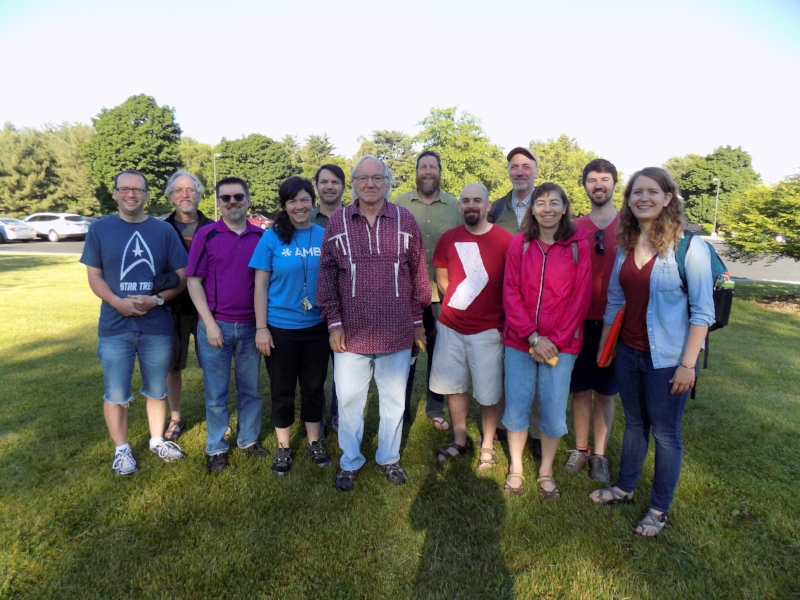
The Anabaptist Mennonite Biblical Seminary is located in Elkhart, Indiana, on what was once Potawatomi land. This past summer I participated in their course: “Trail of Death: A Pilgrimage of Remembrance, Lament, and Transformation” It was a 2-week immersive learning experience of readings, discussions, meeting with Potawatomi of different bands, and following the trail. And we went as descendants of settlers

We had the great gift of having George Godfrey as one of our guides. He is a Citizen Nation Potawatomi whose ancestors traveled the Trail of Death and is the president of the Trail of Death Association.
We are at the statue of Chief Menominee which is near the site of the church where the people were assembled. He initiated our time with a smudging ceremony.
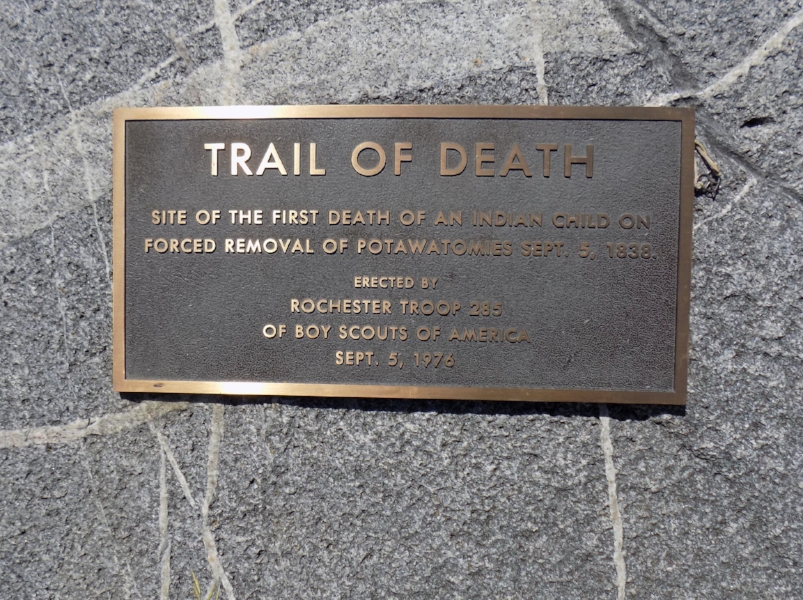
Trail is remarkably well marked with both road signs, and plaques on rocks marking the trail. This was the first plaque, done by a boy scout troop marking the spot where the first child died. The death of children becomes a common occurrence along the trail. The left in early Sept in very hot and dry conditions, and by the time they reached Kansas they were dealing with snow.

There are markers at most of the places where they camped along the way or as close as they can get. Stone plays an important role in marking the trail and holding the story..
As we traveled we read accounts of the original trip from a military diary of each day.
Monday, 24th Sept.
At 9 this morning we left Pyatt’s Point (the encampment of yesterday) and proceeded down the Sangamon river fifteen miles to the place of our present Encampment, Sangamon Crossing. Physician reports “there have been two deaths since my last, and the situation of several of the sick is much worse. I would recommend that twenty-nine be left until tomorrow.” At the suggestion of Dr. Jerolaman twenty-nine persons were accordingly left behind with efficient nurses. They will join us tomorrow. We find a good deal of difficulty in procuring wagons for transportation – so many of the emigrants are ill that the teams now employed are constantly complaining of the great burdens imposed upon them in the transportation of so many sick. Subsistence and forage the same as yesterday. A child died during the evening.

This plaque was in the parking lot of a gas station.
Here we are reading a litany which we read several times each day at the places where we stopped. It was written by Katerina Friesen, who was the instructor for the class.
Litany of Remembrance
Standing where you walked,
We remember you.
Exile under gunpoint,
Loss of scared land,
We remember you.
Bruised feet and weary bodies,
Choked by dust and heat,
Sickness stalking young and old,
We remember you.
We lament this Trail of Death.
Trail of Broken Promises,
Theft of homelands for white man’s profit.
We lament this Trail of Death.
We lament that our ancestors
Did not dwell in peace.
Creator of all, we long for new vision today.
Open our eyes and give us sight
To seek the things that make for peace,
To see the Image of God in all peoples,
Especially those persecuted and oppressed.
Make a new way for us together,
Guide our fee, O Lord, on a Trail of Life.

At one site we gathered at this old oak, which would have been there when the Potawatomi were making their journey.
Along the way we also read from others who helped shape the U.S approach to the Indigenous population. From a letter from President Thomas Jefferson to William Henry Harrison, Governor of the Indiana Territory, 1803
“When they withdraw themselves to the culture of a small piece of land, they will perceive how useless to them are their extensive forests, and will be willing to pare them off from time to time in exchange for necessaries for their farms and families. To promote this disposition to exchange lands, which they have to spare and we want, for necessaries, which we have to spare and they want, we shall push our trading uses, and be glad to see the good and influential individuals among them run in debt, because we observe that when these debts get beyond what the individuals can pay, they become willing to lop them off by a cession of lands.”

Each day we walked a portion of the journey. The journals of the time spoke of the hardships of lack of water and wood while crossing the prairies.

Along the way we met and were hosted by many wonderful people who help keep the story of the Trail of Death alive and shared their own ancestral stories.

Every night we gathered together to reflect on our experiences and thoughts for the day. Each day we responded to two questions: What disturbed you? and What surprised you?
This was a wonderful time of hearing how others are experiencing the pilgrimage and the different perspectives and experiences they brought to this experience.

We reached the end of the trail in Kansas at Sugar Creek Mission. The people on the trail were promised housing and provisions when they arrived in Kansas, and they got none of that. From hardship to hardship. The mission was there for 10 years and in that time 600 Powatatomi died. Their names are inscribed on these crosses. One of our final pilgrimage activities was publicly reading the names of all who had died with responding with "Shodeh" – or "here" – after each name.

On our final evening we were joined by Eddie Joe of the Prairie Band. Eddie Joe is deeply concerned about keeping alive traditional ways and ceremonies. He talked about his story, and his practices, and the ancestors.
We had three themes during our time on the journey:
- Origin stories – we considered how our various origin stories and how they shape who we are today, biblical, national, cultural, personal.
- Exile and Deliverance – The biblical story of Israelites being delivered into promised land is also the story of the conquest of the Canaanites.
- Resisting, Repenting, and Repairing – Okay, so now what are we settler white folk to do. How do we move beyond lament.
[Author’s note - I was deeply conflicted and challenged in creating a conclusion for this. I can honestly say I don’t really know what the right conclusion is - but I had to come to some kind of conclusion for my talk. I will keep reflecting and maybe new insights will be revealed.]
Just as the trauma of African American slavery is still with us, so too is the trauma of colonization of indigenous held lands, the destruction of culture, and taking of lives. These traumas have lingering damaging effects on all of us.
We as the Lansing Church of the Brethren believe God’s liberty and justice does not benefit some at the expense of others. As many of us are descendants of settlers, we need to honestly accept that some of what we see as God’s generosity has been provided at the cost of another’s culture and freedom. We need to lament the wrongs of the past, and the wrongs that are continuing today. But we also need to bear witness to, and sometimes get out of the way of God’s resurrecting and redeeming power which works in and through all.
Some of our way forward; some of our good news is found in the Psalm 25 reading.
8 Good and upright is the Lord;
therefore God instructs sinners in the way.
9 God leads the humble in what is right,
and teaches the humble God’s way.
10 All the paths of the Lord are steadfast love and faithfulness,
for those who keep God’s covenant and decrees.
In Jesus’ encounters with lepers and women and foreigners we see examples of good news for the Canaanites, and for all. Jesus listens to them. Jesus honors their humanity. Jesus restores right relationships.
Good news for the Canaanites, good news for the Native Americans happens when we as settler descendants with honesty and humility listen and remember the stories of those who have been hurt by the policies that have benefited us.
Good news is found in when we join together to resist efforts to harm the land and the water which has nurtured us for thousands of years. Good news is found when honor treaties and recognize the right of tribes to self-rule.
God’s good new for the Canaanites; God’s good news for the Native Americans, is God’s good news for all. It is God’s overflowing, unconditional, and liberating love which seeks justice for all – on earth, as it is in heaven.
(Thanks to David Stoeger for all the pictures.)
God of this place - a prayer

God of winter and spring, of summer and autumn.
God of the day and the night and the beautiful in-between.
God of the north and the south, the east and the west.
God of the universe and the atom.
You are God of this place and this time.
Your presence is found in the present moment.
Help us to plant our feet in this place,
not because it is our place, but it is the place where we are.
Remind us of those who have planted their feet here before us,
who tended this place,
who lived in this place,
who encountered you in this place.
Remind us that our ancestors did not arrive to an empty land.
God of all places, we receive the gift of this place as a gift
not for some, but for all.
Amen.
The Gravity of the Situation - sermon

"Heavy Load" from flickr user amslerPIX
Matthew 11: 16-19, 25-30
The people who went out to see and listen to John the Baptist and Jesus were weary from being pulled down. The people were living with the burdens of poverty, of political occupation, and of oppressive religious demands. The people were looking for a messiah to relieve them of their burdens. Their situation was grave.
The “wise and learned” as Jesus called them, created a system of religious laws that always demanded more of the people. These laws and their strict enforcement placed more and more burdens on the people, pulling them down. They were always on the prowl to heap the burdens of their rules onto the backs of the people, and also onto the back of Jesus.
As Jesus would say in Matthew 23 “They tie up heavy, cumbersome loads and put them on other people’s shoulders, but they themselves are not willing to lift a finger to move them.” Matthew 23:4
The people coming to Jesus had every reason to feel weary and burdened. The gravity of the situation was causing them to be stooped in a position of subservience.
The scribes and Pharisees played the pipe and demanded that the people dance. They sang a dirge and demanded that the people mourn. And if they didn’t, as John the Baptist and Jesus didn’t, they were mocked and punished
All that weight. All that gravity. It was pulling the people to their graves. They longed to be free of their burdens. Even Jesus, in the Garden of Gethsemane asked that his burden be removed from himself. Even he too felt the weight pulling him down.
Many of the people Jesus spoke to lived lives that required them to carry heavy physical burdens. Many of us today who read this Bible text do so from a place of privilege. It isis safe to say that the more privileged you are, the less weight you need to carry to survive. I don’t need to walk a couple miles carrying my family’s water for the day. I don’t need to carry bundles of shingles up ladders to earn minimum wage. In my place of privilege there are systems in place that protect me from the forces of gravity.
And yet, despite our privilege, each one of us could name how we feel weary, or name the burdens that are pulling us down. While different than the burdens of the first century followers of John and Jesus, they are no less real. Nor are they of any less concern to Jesus. Gravity may not be breaking our backs, but our burdens are crushing our spirits.
Often the burdens we take on are perfectly good and necessary. Just as the scribes and Pharisees were trying to come up with rules to create an orderly society, many of the burdens we take on are not bad things. But they become our burden when they fall out of God’s intention for our lives.
We bear the burden of perfectionism.
We bear the burden of feelings of inadequacy.
These things weigh us down.
We bear the burden of self-righteous judgement.
We bear the burden of feeling that we need save the world.
These things weigh us down.
We bear burdens of illness.
We bear burdens of loss.
We bear burdens that we can’t even acknowledge to ourselves.
And gravity pulls us and our burdens down.
Sometimes we take on burdens because we give in to societal expectations.
Sometimes we take on burdens to give our lives meaning.
Eventually we may come to see our burdens as our identity. I am weary. I am burdened. That is who I am.
The gravity of all our burdens is great.
This same gravity that is pulling us down pulled Jesus and the world’s burdens down to his grave.
So what is Jesus’ response to his followers?
Jesus sees the burdened and the weary people. He sees those stooped over bending to gravity and he first invites the them to come to him. He welcomes them.
Jesus doesn’t judge the people for bearing those burdens. Jesus doesn’t say “You should have known better than to follow those foolish scribes and Pharisees.” He simply invites them to come, and he offers them rest.
Jesus responds to the burdens of economic, political and religious oppression with the gift of rest. Rest is an image of salvation. Rest is sabbath. Rest is shalom. Rest is what it looks like when the world is ordered as God intends.
Most importantly, rest is not another burden the followers must bear. God provides the rest. It is a gift.
John the Baptist and Jesus, through their very different lifestyles modeled what it looked like to live free of those weighty burdens. John and Jesus subverted those regulations, those burdens. When the Pharisees played the pipe, John didn’t dance. When the scribes played the dirge, Jesus didn’t mourn.
Free of the heavy burdens, these receivers of Christ’s rest are enabled to stand up straight; to stand with dignity. No longer stooped over, they can raise their eyes from the ground to look out ahead of them.
And, unburdened and rested, Jesus invites the people to take on his yoke. Jesus’ followers weren’t to live a life free of all constraints and guides. The life of following Jesus is a life of discipleship and a life of abiding in God’s rule of love.
Jesus is quick to reassure his listeners (and me) that his yoke is easy and light. Jesus reminds us that he, unlike the scribes and Pharisees, is a gentle teacher
This same invitation of welcome and rest that Jesus offered 2000 years ago he offers to us today. Jesus offers us rest and relief from our battle with our burdens, from our battles with the downward pull of gravity.
This invitation is offered to all – because all are weary and burdened. Jesus knows we’ve taken on many of these burdens because we are just trying to do the right thing, but Jesus calls us to let go of these burdens. Take them off and let gravity pull them far away from you. Our situation is not grave. Our burdens are not our identity. Gravity doesn’t have the final say.
Cast off our burdens and take on his yoke.
The idea of no burden and no yoke is attractive, but God is doing great work and God believes in us and God knows that yoked with Jesus we can participate in God’s work. This is the work God has been doing for millennia and will continue after you are gone
God is simply asking us to get with the work God is already doing and be yoked with Jesus. A life of humble service freely given, not slavery to the master of oppressive demands.
What does this invitation to be unburdened look like for us and our church?
Imagine how much lighter our load would feel if our church could remove the burden of feeling insufficient, of being too small, and rest in Jesus’ yoke of divine abundance.
Imagine how much lighter our load would be if we could remove the burden of working hard and being busy to demonstrate our faithfulness and usefulness and took on Jesus’ yoke of simply being loved and valued for who you are.
Friends, our situation is not grave.
Gravity does not have the final word.
Jesus’ uplifting and resurrecting power, his light and restful yoke is generously offered to us all.
Arise, stand up straight, and receive this gift.
Amen

Fave albums of 2016
These are the albums I most listened to in 2016. They are not necessarily released in 2016.
Songs From the Lough Swilly Delta by Little John Née and the Caledonia Highly Strung Orchestra

This is one of those albums that harkens me to a time and place. I saw Little John Nee perform at a house concert in Galway, Ireland. He is a wonderful musical storyteller who fills songs with charm and wit and this album is currently seeing near constant play in our car’s cd player. (He also introduced me to the cigar box guitar.)
You Want it Darker by Leonard Cohen

As a Canadian, Leonard Cohen has been on my cultural radar for decades. I would describe myself more as an appreciator than a fan. I've read some of his poetry, and a novel, and listened to his music, but I thought his song-writing ability surpassed his song performance ability. I went back to listen to The Future a month or two ago and struggled to get past the 80s synthesizer and the overproduction. But, his last and final album is the best match of song, voice, and production. The album is dark and rich.
Living On a High Note by Mavis Staples

A genuine highlight of my year was seeing Mavis perform and then getting a hug from this beautiful woman. I am a big Mavis fan and so I'm naturally inclined to like anything she does. I will admit, however, this album took a few listens to grow on me. My initialresponse was that the album was too cheery. The Jon Batiste song seems like it was written for a Pixar movie. Oh, and not enough gospel influences. But repeated listens has developed a deeper appreciation for the album. (Another Mavis involved release I listened to a lot this year was the Faith and Grace a 4 cd set of early Staple Singers music.)
Cruel Sunrise (Deluxe Edition) by Rick Holmstrom

I became aware of Rick Holmstrom in his role as Mavis’ guitarist for several years. So, along with seeing Mavis perform, I was delighted to closely watch and listen to Rick’s playing. I also got to briefly chat with him the morning after the concert, but I didn't ask him for a hug. Shortly after the concert I purchased this album which is straight-up 3-piece-band blues. My favorite part of the album is the “deluxe” extra cd of instrumental music. It seems like when the singing and the lyrics can be set aside that the musicianship of the band really shines through.
PanolaCounty Spirit by theWalker Family Singers

Another great release of, as my friend would put it “moanin’ gospel” from theDaptone Records label. If you liked their Como Mamas album, which I did, then you’ll probably like this. This album was recorded in the family's Mississippi living room and is simply about their powerful a capella gospel singing.
10 Recommended Podcasts
10 Recommended podcasts (in no particular order)
Podcasts are all about putting things on your ears and listening – and it’s best if it is attentive listening. So, it shouldn’t be too surprising that I like podcasts that are about sound, or just sound great. Here is a list I would personally recommend today.
Sound/Music related
Twenty Thousand Hertz

A new podcast that tags itself as “The stories behind the world’s most recognizable and interesting sounds.” This shows is created by a sound design team and definitely requires use of headphones.
The World According to Sound

Yes, the first thing you will notice about the podcast is episodes are just 90 seconds long. They introduce a sound and play the sound.
Sound Opinions

A good music criticism show from WBEZ in Chicago. The hosts, Greg Kot and Jim DeRogatis do a good job of expanding my musical awareness. Like most music critics, they have a fondness for music that I think only music critics enjoy.
Great Sounding podcasts
The Memory Palace

It took me a little while to warm up to this show, but I’m now a devoted fan. The stories are fascinating pieces historical research and the writing and the narration are wonderful to listen to.
Here Be Monsters

Love + Radio

I’m going to confess, I sometimes get these two podcasts mixed up, but that is because they are both wonderfully audio-rich explorations of often-challenging subjects. Before beginning an episode from either show I pause and assess whether I’m ready for this.
Religious
Spiritual Steps
Each episode is a brief invitation to a spiritual discipline. Steven Hovater is a gentle teacher and okay, some of the charm is his southern drawl.
The Rhythm Divine

Combining my appreciation of audio and spirituality, this show from Australian Broadcasting Corp Radio National features spirituality and music from many different traditions. And yes, here you get to listen to a lovely Australian accent.
Miscellaneous
How to Be Amazing

Michael Ian Black is my favorite interviewer (sorry Terry Gross.) He really listens to the people he’s interviewing and asks insightful, follow-up questions. I also appreciate that he is quick to ask clarification questions when he doesn’t understand something. (I loved his interview with Krista Tippett.)
HowSound

HowSound is the “How it’s Made” of radio storytelling. In each episode, Rob Rosenthal dissects a radio piece. It is a wonderful and learning opportunity to listen to radio stories through his critical, professional ears.
Write here...
When the storms of life are raging, Testify
My sermon preached on Nov. 13, 2016 The text is Luke 21:5-19
“ When some were speaking about the temple, how it was adorned with beautiful stones and gifts dedicated to God, he said, ‘As for these things that you see, the days will come when not one stone will be left upon another; all will be thrown down.’
They asked him, ‘Teacher, when will this be, and what will be the sign that this is about to take place?’ And he said, ‘Beware that you are not led astray; for many will come in my name and say, “I am he!” and, “The time is near!” Do not go after them.
‘When you hear of wars and insurrections, do not be terrified; for these things must take place first, but the end will not follow immediately.’ Then he said to them, ‘Nation will rise against nation, and kingdom against kingdom; there will be great earthquakes, and in various places famines and plagues; and there will be dreadful portents and great signs from heaven.
‘But before all this occurs, they will arrest you and persecute you; they will hand you over to synagogues and prisons, and you will be brought before kings and governors because of my name. This will give you an opportunity to testify. So make up your minds not to prepare your defence in advance; for I will give you words and a wisdom that none of your opponents will be able to withstand or contradict. You will be betrayed even by parents and brothers, by relatives and friends; and they will put some of you to death. You will be hated by all because of my name. But not a hair of your head will perish. By your endurance you will gain your souls.”
What do you do when the world around you seems to be falling apart? What do you do When things you had placed great confidence in begin to crumble, or you discover they are a lie?
How do you prepare for predicted disaster and devastation?
Many in this country have predicting and proclaiming the end of things as we know them. Internal and ideological wars and rumors of wars have filled our tv screens and Facebook feeds. Many, many people have appeared and said I am he, or I am she. Only I can save this country.
People have been arrested while protesting the value of black lives and protecting sacred land. Nations have risen up against nation, party against party, neighbor against neighbor.
The times we live in don’t sound that different from Jesus’ words in our gospel text this morning. So. What does this mean? Are these the “End Times” – that time that people since even before the time of Christ have felt are imminent? And if these are the times that Jesus seems to be talking about – what are we to do? Our temptations range from sticking our head in the sand and ignoring what’s going on around us to mounting an angry rebellion. And either of those responses seem reasonable – and were common to Jesus’ time as well.
Let’s step back a little from the emotion and the rhetoric from our reading and from current events and look a little closer at the text.
Jesus and his disciples have been hanging out at the temple in Jerusalem. Just before these verses they had watched the widow drop her 2 coins into the offering plate. Once again, Jesus was using an old woman, a widow to teach these young men what life in God’s reign looked like. After that I guess nothing much was happening and the disciples started laying back and looking around. “I can’t get over how amazingly big and beautiful this place is. All that gold and gems everywhere. And all this to glorify God. Have you ever seen something like this Jesus? Isn’t it wonderful?” Those seem like perfectly legitimate responses to the grandeur of the temple.
Jesus quietly looked around for a bit “As for these things that you see, the days will come when not one stone will be left upon another; all will be thrown down.”
“Say what?!”
This temple was a symbol of Yahweh’s relationship with God’s chosen people, and a symbol religious security and strength. Announcing its destruction would be a little disconcerting.
Now, this temple they were sitting in was also known as Herod’s temple – this wasn’t the Herod that tried to kill Jesus as a baby, but that of his Father. Yes, this was a place for the Jewish people to gather to worship, but like any good political leader, Herod had spent time visiting neighboring countries and saw the amazing temples built to their gods, and well, like any good politician, he didn’t want to be outdone. So, he made sure “his” temple was as good as theirs, if not better. Public works projects and personal vanity have been with us for millennia. And, let us not forget that Herod was an agent of the occupying Roman empire. As we know from the story of Jesus’ passion, local religious and political leaders were pretty intertwined. It seems that as much as the temple was a place of worship and religious identity, it was also a symbol of political domination and hubris.
Political and religious forces had taken an institution that was supposed to be a place where the people of Israel worshiped Yahweh, and turned it into a political tool to help uphold the empire.
So, even though this place still had deep religious resonance for the people – and for Jesus as well – perhaps we shouldn’t be too startled that Jesus essentially declares “The foolish man built his house on the sand and the walls will come tumbling down.”
Not surprisingly, the disciples are surprised by this declaration and want more information. “Teacher, when will this be, and what will be the sign that this is about to take place?”
There they are lounging underneath the high ceiling and heavy walls of the temple, and Jesus says that this place is going to crumble – so, yeah, they want to know when and if they should leave, now. But I find it curious they also ask “What will be the sign this is about to take place?” They want to know what will happen before this destruction is about to happen. They want to know when and how to prepare.
To recap the story so far. The disciples are marveling at how beautiful the temple is, Jesus tells them it is going to fall apart, and the disciples urgently want to know when.
In response to the question Jesus begins a progressively dark and discouraging description of future events. (With language that feels all too current.)
Early on in his reply, however, Jesus gives a warning to their pressing question of “when will this happen.” He says people will come saying the end is near – and Jesus tells the disciples – ignore those people. His instructions in these couple of verses – “Don’t be deceived. Don’t follow them. Don’t be terrified.” The disciples’ big questions are when will this happen, and how do I prepare, and Jesus recognizes their anxiety and tells them to chill. Jesus knows that the events he is discussing have reason to cause people to be anxious and afraid and he knows that fear is not conducive to good decision making. Jesus warns, Don’t feed into the chaos going around you. Don’t become another cable news head yelling idiotic things at other people yelling idiotic things. And don’t trust people who offer easy answers that feed your fears. Be wise, be cautious, and don’t be afraid. My very loose paraphrase of Jesus’ response “Don’t forget to breathe, and don’t be stupid.”
But then he goes on to describe horrible future events. But his description of all the horrible events messes up with anybody’s attempt to create a timeline. “When you hear of wars and insurrections, do not be terrified; for these things must take place first, but the end will not follow immediately.” 10Then he said to them, “Nation will rise against nation, and kingdom against kingdom; 11there will be great earthquakes, and in various places famines and plagues; and there will be dreadful portents and great signs from heaven. 12“But before all this occurs, they will arrest you and persecute you”
Jesus is not trying lay out the linear flow of future events. In fact, it seems like Jesus is trying to intentionally thwart any efforts to draw out a logical progression of events. I think Jesus is simply describing the world as it is, or as it can seem.
It is a noteworthy to remember, that the Gospel of Luke was written in the latter half of the first century – scholars suggest around the year 85. This temple that the disciples were sitting in and admiring – it was destroyed in 70 AD, 15 years earlier. All the people reading this text know the temple as a destroyed ruin, and these people live a deeply persecuted life. So, for the first readers or hearers of Luke’s gospel, their reaction to Jesus description will likely be (like ours is) “Yes, that describes the world as it is right now.”
And all this brings us to what I think is the key to this passage – this is the message that Jesus had for his disciples and for us. “This will give you an opportunity to testify.”
All these things that are happening – the war, the portents, the persecution – they are going to happen. And what should your response be?
“Testify.”
“Go out and make disciples.”
“Testify.”
“Make a joyful noise to the lord.”
“Testify.”
Testify that the stone that the builders rejected has become the cornerstone.
Testify that the one who is able to destroy the temple, in three days will build it up again.
Testify in word and deed to the love and justice that you know is true.
And because Jesus knew well his disciples (and us) and our propensity to anxiety and worry, he knew to immediately add “make up your minds not to prepare your defense in advance for I will give you words and a wisdom that none of your opponents will be able to withstand or contradict”
As Jesus so often tells his disciples he once again tells them – don’t worry. Don’t worry about when these things shall happen, don’t worry about what we shall say, don’t worry about what we shall eat and drink. I am with you, and that is all you need.
After Jesus warns against being anxious about preparing, he ends this passage with a challenge. “By your endurance you will gain your souls.” Earlier Jesus called us to testify, and he ends by telling us not to stop testifying. We are to respond to the never-ending flow of news and of our own experience of war, violence, and persecution with our own endless testifying to the love and forgiveness of God.
Another translation ends this section with “By your perseverance you will secure your lives.” This topic of perseverance should be a familiar one for some of us as a few Sundays ago Melanie preached about the widow who kept bothering the judge and Jesus’ instruction to persevere in prayer.
This past Monday I sat with the group in the basement of St John Student Center where we prayed and meditated on this scripture. And within that time of silent meditation the theme of perseverance came to the foreground as something for me to pay attention to. Then, Tuesday morning, I was up early as and resumed listening to an audio book about Lakota Native American stories and teachings and the very next chapter was all about the value of perseverance. All this may all just be for me – but I feel like God is trying to tell me something.
Testify, and don’t give up. Our relationship with God, and with others, and the coming of God’s reign is not a one and done event. They are the results of our continually putting one foot in front of the other – even when you feel discouraged and even when you cannot see more than a foot ahead of you, even when there are wars, and false leaders, and persecution. We don’t testify to the love of God only when we really feel it or when it fits our schedule or when it feels safe to do so, but we keep testifying. We persevere because we have hope.
To recap, let’s look once again at Jesus’ instructions to his anxious disciples.
• Don’t be deceived and don’t be misled.
• Don’t be afraid. Don’t be anxious.
• But testify. And despite everything going on around you, or more importantly because of everything going on around you, keep on testifying to the thing you know to be true. The love and justice that God desires for everyone and for all creation.
Amen