
Looking for Jesus in all the wrong places - Ascension Day Sermon

I used to work at a large library. It was Michigan’s state government and history library. It was four stories tall with hundreds of thousands of items in its collections, books, periodicals, government documents, maps, microfiche. I supervised our student workers and one of their jobs was shelving books. This also meant they looked for missing materials. When they just could not find the missing piece they came to report this to me. My common, if cheesy response to them was “If you don’t find it where it belongs, you look for it where it doesn’t belong.” I had a bit of a knack for intuiting where these wrong places might be.
It's easier to find something if you know what it is you are looking for. Imagine playing Where’s Waldo if you have no idea what Waldo looks like. Where would you begin to look?
In our Acts text we find the disciples staring up into the sky. Looking for something that wasn’t there. This is the same direction which Jesus just departed from them. Jesus was taken up into the sky. I recently saw an ancient painting of the disciples looking up and all that was visible at the top of the painting were Jesus’ pierced feet.
I can imagine the levels of confusion these disciples were dealing with at this moment. “Just a little while ago he died, and when we looked at the tomb, he wasn’t there, and then he just showed up. And now up he goes into the sky. Poof. And he’s gone again. So is this just another short term thing? Really, what on earth is going on anymore. I’m soo confused.”
And while they were staring up into the sky two white robed men appeared and asked “Men of Galilee, why do you stand looking up toward heaven? This Jesus, who has been taken up from you into heaven, will come in the same way as you saw him go into heaven.”
White robed guys asking questions about an absent Jesus was starting to be a pattern. Remember back in Luke when the women went to the tomb to look for the body of Jesus, and again our white robed guys appear and ask “Why do you look for the living among the dead? He is not here, but has risen.”
Every time they look for a missing Jesus these guys show up and say “Nope, not here. Not in the grave, not in the sky.”
So then, where do we look for Jesus? Where do we expect to find Jesus? How do you even know if we’ve spotted him? These disciples who had spent 3 years with Jesus were still looking for him and were quite puzzled about his absence.
Much earlier in his life, Mary and Joseph went looking for the young Jesus, who was not where they expected him to be. They returned to Jerusalem and found him in the temple talking with the religious leaders. This is not where you expect to find a 12-yr old boy. The women coming to the tomb looking for the body of Jesus did not find him where or how they expected. The Pharisees often found Jesus in places they didn’t expect him to be, with tax collectors and sinners.
The messiah even appeared as a baby in a stable born to a young virgin. This is not where or how we expect to find the messiah.
The opening verses of our Acts text begins with the disciples asking Jesus “Lord, is this the time when you will restore the kingdom to Israel?” They were still thinking that the Jesus they were looking for was a political leader. Jesus was right in front of them, but they couldn’t quite find him.
Once again, where do we look for Jesus? Where do we expect to find Jesus? How will we even know when we’ve spotted him?
Finding the divine in unexpected places is not unique to the New Testament. God’s presence in the Old Testament, the First Testament often comes in unexpected forms.
From 1 Kings 19
God said to Elija, ‘Go out and stand on the mountain before the Lord, for the Lord is about to pass by.’ Now there was a great wind, so strong that it was splitting mountains and breaking rocks in pieces before the Lord, but the Lord was not in the wind; and after the wind an earthquake, but the Lord was not in the earthquake; 12 and after the earthquake a fire, but the Lord was not in the fire; and after the fire a sound of sheer silence. 13 When Elijah heard it, he wrapped his face in his mantle and went out and stood at the entrance of the cave. Then there came a voice to him that said, ‘What are you doing here, Elijah?’
God was not in the powerful acts of great winds, of splitting mountains, of earthquakes, fires. Not in these “acts of God” but in the sound of sheer silence did Elijah hear God’s voice. In silence Elijah found God.
From Exodus 3
Moses was keeping the flock of his father-in-law Jethro, the priest of Midian; he led his flock beyond the wilderness, and came to Horeb, the mountain of God. 2There the angel of the Lord appeared to him in a flame of fire out of a bush; he looked, and the bush was blazing, yet it was not consumed. 3Then Moses said, ‘I must turn aside and look at this great sight, and see why the bush is not burned up.’ 4When the Lord saw that he had turned aside to see, God called to him out of the bush, ‘Moses, Moses!’ And he said, ‘Here I am.’ 5Then he said, ‘Come no closer! Remove the sandals from your feet, for the place on which you are standing is holy ground.’ 6He said further, ‘I am the God of your father, the God of Abraham, the God of Isaac, and the God of Jacob.’ And Moses hid his face, for he was afraid to look at God.
Moses found God in a fiery bush. Moses wasn’t looking for God, and when he saw the burning bush he didn’t think “Oh look, there’s God.” I’m intrigued that Moses, turned aside to see the bush. This turning aside reminds me of Jesus’s call to metanoia, to repent, to turn around, to change one’s mind.
One key difference between these two stories of Elijah and Moses, and our New Testament stories of disciples is that while the disciples were looking for Jesus, Elijah and Moses were not out looking for God. Elijah was fleeing and asking that his life be ended and Moses was just out tending his flocks. These people weren’t looking for God, but God revealed God’s self to them.
Maybe our efforts at looking for Jesus, looking for God are misdirected. Maybe we are looking for Jesus in the wrong places. We’ve learned from the white-robed men that we won’t find him looking down among the dead, and we won’t find him looking up into some way beyond. Maybe we are even fooling ourselves thinking we can find Jesus.
Is Jesus, Is God there to be found like a lost coin? Will shining a light and sweeping all our corners lead us to find Jesus? Or is Jesus more inclined to just show up and be found, in a locked upper room, in a Garden by an empty tomb, at a table breaking bread in Emmaus? Does God, out of God’s own generous will simply reveal God’s self to us? Is it perhaps not on account of our looking that we “find” God. Christopher Columbus did not “find” the new world. Perhaps we do not “find” God. Perhaps we are found by God. Perhaps God reveals God’s self to open hearts ready to receive.
Or maybe it is both. Maybe our seeking is necessary. Maybe’s God revealing God’s self is necessary. Maybe finding and being found, maybe seeking and being sought, maybe these together are an essential to our relationship with God.
Just before my meditation we sang one of my favored hymns. The first verse reads “I sought the Lord, and afterward I knew he moved my soul to seek him seeking me. It was not I that found, O Saviour true, no, I was found of thee.” That verse pretty much summarizes what I have to say.
Both God and us seek and are sought. We both find and are found. We are completely separate from, and intimately one with God. There is a mutuality of desire and action between us and God. The kingdom is now and not yet.
If part of our call is to be found by God, how do we do that? How do we open ourselves to be found by the one we are seeking? How can we be good soil ready to receive the seed of God’s word? If we had problems with the question of where do we find Jesus, I think the question of how do we be found by Jesus is even more challenging. How do we prepare our hearts to receive the one we seek? How do we allow, and assent to God’s presence within us.
The final sentence in our Acts passage offers an important clue to answering this challenge of seeking God, and preparing our hearts to be found by God. After the ascension when the disciples had reconvened in Jerusalem, the verse reads “All these were constantly devoting themselves to prayer, together with certain women, including Mary the mother of Jesus, as well as his brothers.”
As fun as it is to make fun of the disciples for sometimes seeming clueless about what was going on, they show some deep wisdom here. They have learned that Jesus is not to be found among the dead and Jesus is not to be found in some far off home in the sky. They might not have completely figured out how to find Jesus, but in gathering together to spend time in prayer and reflection the disciples were opening their hearts in the direction of God and becoming attuned to God’s presence already among them.
As Jesus seemed absent, the disciples reconvened as a community of prayer. Perhaps they did this to try to regain the intimacy and immediacy of Jesus’ physical presence that had been with them. Perhaps they learned by Jesus’ example of repeatedly going off to pray. Perhaps they couldn’t imagine connection with God, without connections with each other.
In this gathered community of prayer the disciples, and ultimately us, continue the practice of seeking and being sought, of finding and being found. In this community of prayer we prepare our hearts to receive God in ways we might never have imagined possible. Together in prayer we till and nourish the soil to be ready for the divine seed of God’s word.
The call to be a community of prayer is not a call to withdraw from the world, but in this community of prayer we develop an awareness to be attuned to God’s presence in the world. While the outpouring of the holy spirit in Pentecost has not yet arrived, the disciples gathering in prayer are preparing themselves to receive God in these tongues of flame, and be empowered to bring the presence and power of God to all the world.
Where do we look to find Jesus? Gathered in the prayerful community, in a mutual relationship of seeking and being sought, Christ opens our eyes so that we may find Jesus wherever we look.

Retreat Centre Exploration Meeting

Below is a letter I sent to some people in southern Manitoba, but the invitation is open anyone who is interested.
Greetings
Are you eager for a place of spiritual retreat? A place that emphasizes silence and solitude? A place of rest, prayer, and contemplation?
I invite you to join a conversation where like-minded people will begin exploring the possibility of such a place in southern Manitoba.
I am Kevin Driedger, a resident of Winkler and member of Covenant Mennonite Church. For the last 23 years I’ve been associated as a volunteer, board member, staff, and director of The Hermitage, an ecumenical contemplative retreat center in southwest Michigan. I know the impact a place like this can have on all who take time for retreat. I’m also aware of the paucity of similar places in southern Manitoba.
I invite you to join this initial conversation on May 23, at 7pm. The meeting will be held at Covenant Mennonite Church in Winkler, but we'll also make a Zoom link available if people wish to join online.
Everyone who has any interest or curiosity about a space for retreat is welcome to attend. Please share this with anyone you know might be interested.
Please let me know if you would like to participate in this meeting either in person or online, or let me know if you have any questions.
Kevin Driedger
ksdriedger@gmail.com
Hope in a barren tree

“One day in winter he [Brother Lawrence] was looking at a barren tree, stripped of its leaves, and considering how in a little while these leaves would reappear, green, followed by flowers and fruits, he received a profound awareness of God’s kindness and power that never left his soul since.”
(Practice of the Presence, a revolutionary translation by Carmen Acevedo Butcher.)

Manitoba Mennonites, Is it time for a retreat?
Marlene Kropf recently wrote to Mennonite Church USA members “Is it time for a retreat?” My response is a resounding yes! Until recently I lived in Michigan I could answer that response by visiting a variety of places like Pathways Retreat in Goshen, Indiana, or within a few miles of each other near Three Rivers, Michigan I had the choice of St. Gregory’s Abbey, Apple Farm retreat center, GilChrist retreat center, and The Hermitage (a retreat center with Mennonite roots that I have been deeply connected to for more than 20 years.) This list does not include the many Catholic and independent retreat places all within a 90 minute drive from home. I didn’t realize the abundant gift of this area until I left.

Late last summer June and I moved to southern Manitoba, and now any attempt to heed the call “Is it time for a retreat?” appears to be much, much more difficult. When I’ve ask others, the most common answer is, “I knew some people used to go to X, but they closed.” I know the Mennonite camp is interested in being a place for congregational spirituality, but rows of camp bunkbeds and large noisy dining halls are not conducive to silence and solitude.
So, Manitoba Mennonites, Is it time for a retreat (center)? This question is not exclusively directed at Mennonites, as I know the desire for a space for retreat extends through many expressions of the Christian faith.
I’ll put my cards on the table. The ministry of operating a quiet space for prayer and contemplation has been the most fulfilling work I’ve done over these past 20 years as volunteer, board member/chair, staff, and director at The Hermitage. I have seen first-hand, over and over again what a valuable service this is for people. I have seen so many people arrive to their retreat in anguish and leave with a sense of rest and their own belovedness. I have been intimately involved with the nitty gritty of fund-raising, financial compliance, facility maintenance, managing staff and volunteers, and doing endless loads of laundry and the relentless need to prepare another meal. I have few romantic notions of operating a retreat center. I often told people that the work of running a retreat center is “work”. And this work is the fullest expression of my spiritual life.
And so, I want to do whatever I can to work with others to discern the needs and possibilities for there to be a space for retreat available for all who need and desire it. I have little idea what that process might look like, but I don’t feel like I have a lot of time (or patience) to endlessly dream.
I am going to spend the next few months trying to make connections and find people for whom the dream of a place for contemplative retreat resonates with their souls. I would love to gather a group in early summer to discuss and imagine together. It is my hope that any gatherings not simply be times of pondering, but that these times lead to some actionable next steps. This needs to be a community supported project and I’m very aware of the audacity for me to say, “I need to do this and I want you to come alongside to help make it happen because you want it too” but that’s where I’m at.
So, if you find any resonance with this idea, or if you know someone who might, please contact me either via my contact page, or at ksdriedger@gmail.com

In Praise of the Useless Mennonite*
I have a compulsion to be useful. Growing up I absorbed/adopted the idea that usefulness was next to godliness. Or perhaps usefulness was godliness. I think I’m really good at being useful. I wish I wasn’t.
Christian usefulness is an important value and characteristic of north American white Mennonites. But I wonder when our emphasis on usefulness as a personal religious value is really just an expression of extractive capitalism. Just as a land’s value is based on how much economic worth we can get out of it, a useful person’s value is dependent on how many service hours they can provide. How much hardworking good can a person do to achieve greater good for all. Any evening spent tying comforters for MCC is more useful and of greater value than an evening reading a novel or playing with Lego®.
I think usefulness is a distraction from our true work.

I want to sing the praises of the useless Mennonite. The useless Mennonite shifts the location of their value. The useless Mennonite detaches their value from their accomplishments, or the good they achieved. The useless Mennonite rests in God.
Some of the greatest Christian activities are prayer and worship. This is not prayer for the purpose of negotiating some transaction with God. Not prayer to cajole God to accomplish something, no matter how good. And this is not worship for the purpose of being a pre-cursor to fellowship hour. But rather, useless prayer and worship is simply recognizing one’s presence with God’s presence. In useless prayer and worship the only transaction is God freely loves you and you freely love God.
We are all familiar with the two greatest commandments: to Love God with all our heart and mind and soul, and to love others as ourselves. How often do we Mennonite skip over the loving God part and get to the loving others part? Do Mennonites have conferences, working groups, and retreats to reflect on loving God? We may have, but I’m not certain. But Mennonites do have conferences and working groups to think and meet about loving others. This Mennonite understanding of loving others is best expressed by serving others for the cause of justice.
Service itself is not a bad thing, but I think the motivation for service can reshape service from useful to useless. I’ve been pondering service as a sacramental activity; service as an act of worship. The purpose and practice of sacramental service is to open ourselves to bear witness to God’s presence in the other and to then love and worship God through your interaction with that person. The purpose of sacramental service is not to achieve great social change, but to love God. Brother Lawrence’s mode of life was to do everything, even flip an omelet in his frying pan, for the love of God.
Being a useless Mennonite does not mean not getting anything done, it means not doing something primarily to accomplish something, but first to do that thing for the love of God.
I used to work at the Hermitage, a contemplative retreat center that offered space for silence, solitude, and rest. During my time there I began to realize that rest was one of the greatest gifts for a person to receive on retreat. Too often I had people arrive with stacks of books to read and an agenda of all that they wanted to accomplish. A I welcomed them I would often encourage them to start first with a nap. The useless practice of rest and silence creates space within ourselves to hear God. And what could be more valuable than that? We do not accomplish God’s presence. We do not achieve a listening heart. We let go of all our useful activities and allow God’s presence to fill us.
The goal of the useless Mennonite is to detach themselves from their striving, serving, and accomplishing. The useless Mennonite may still be active in serving, and accomplishing great things, but that is not their goal. Their goal is simply to love and worship God in all they do. The useless Mennonite lives out the moniker “the quiet in the land” not by holding the world at a distance, but in resting with reverence and awe in the loving presence of God.
* My use of Mennonite in this piece is referring to north American, white Mennonites. And my use of Mennonite includes poorly informed, over-generalizations for my own convenience.

Winter Winkler stroll
The temperatures are above -20C. I have a new/used zoom lens. You miss all the photos you don’t take. So, I walked around a couple blocks and took a few shots.

Hydrant by our house

City Hall


Closed Sorry Migraine


I love these two old buildings.


Encouraging words & Photographer

Encouragement is a great thing.
I’ve had a few experiences of encouragement lately.
A friend and colleague asked me to take some photos of him as promo pieces for his burgeoning music career.
Kind words were offered in response to some photos with text I offered for a Visio Divina project.
A photographer/Instagramer from the UK said very kind things about me and my work on his regular Friday video.
Not surprisingly, I can be my harshest critic and routinely think I’m a hack and should just stop. Too often I find it easy to dismiss people’s compliments because they are just family or they are just trying to be nice. It’s quite the act of dismissal not to believe the words they say are true.
Occasionally, there are cracks in my armor and I can actually receive and celebrate these encouraging words. And sometimes I believe them.
I added the label “Photographer” to my Instagram account today. Of course, I feel like an fraud doing that, but perhaps by seeing that word there I will learn to accept that label.
Never underestimate the value of a few words of encouragement.

Photo Anxiety - Picturing Winkler
One of my many anxieties is worrying about if I’ll ever find something interesting to photograph again. This is dumb and annoying. It feels like the experience of staring at a blank page and thinking I’ll never find something to write or paint ever again. It’s actually less about finding something interesting to photograph than if I’ll be able to create an interesting photograph.
When I lived nature-filled woods of southern Michigan I was certain there were no more trees, branches, leaves for me to find any interest in.
Now that I live in the flat, bare, suburbia of Winkler I often sit inside certain that my surroundings have nothing to offer me and my camera.
At least the rural woods of Michigan had the advantage of not having any people around to notice me and my camera. In Winkler there are people everywhere, and they seem to like being outdoors. This means I also need to overcome the anxiety of people seeing me take pictures. Changing lenses and getting out my tripod so I can take a closeup of an interesting pattern in a sidewalk that people are using is just not something that I feel I can do. Photographer imposter syndrome is not unfamiliar to me.
And yet, sometimes I am able to tamp down some of those anxious voices, grit my teeth, and, with low expectations, head out with my camera.
No matter where I am, doing this has almost never let me down.
Here are a few such shots from my new (old) home of Winkler, Manitoba.


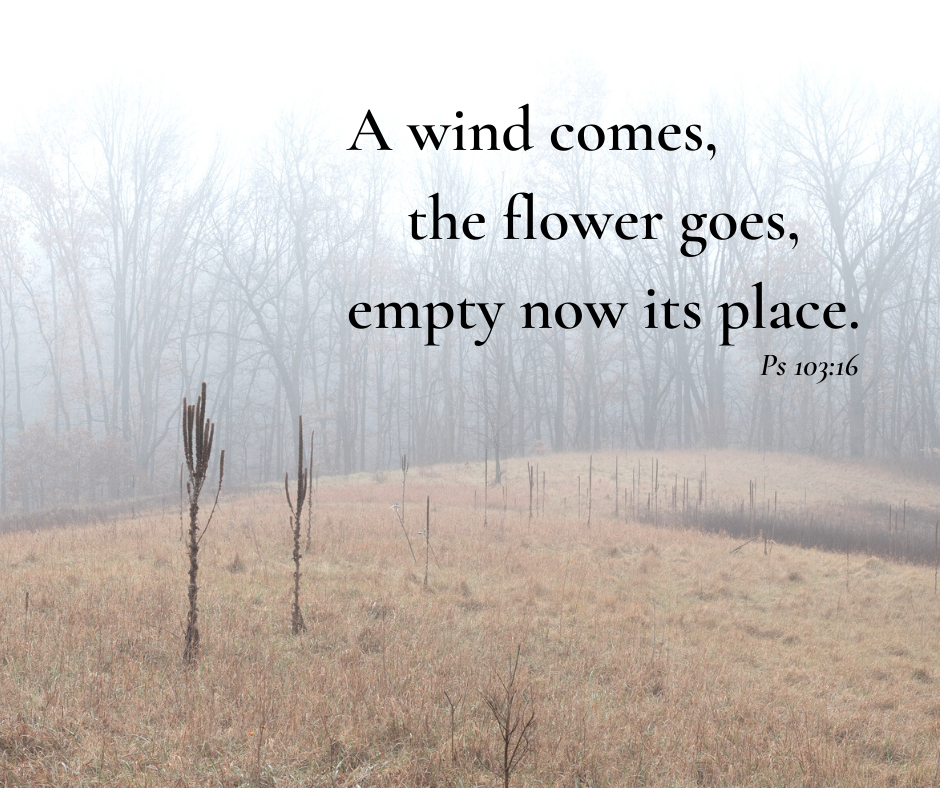
Empty now it's place

Since spending nearly 20 years working in preservation I have been very aware of the language about decay and the vulnerability of life in the Psalms. Some day I’d like to write something about that, but in the meantime we have this.