
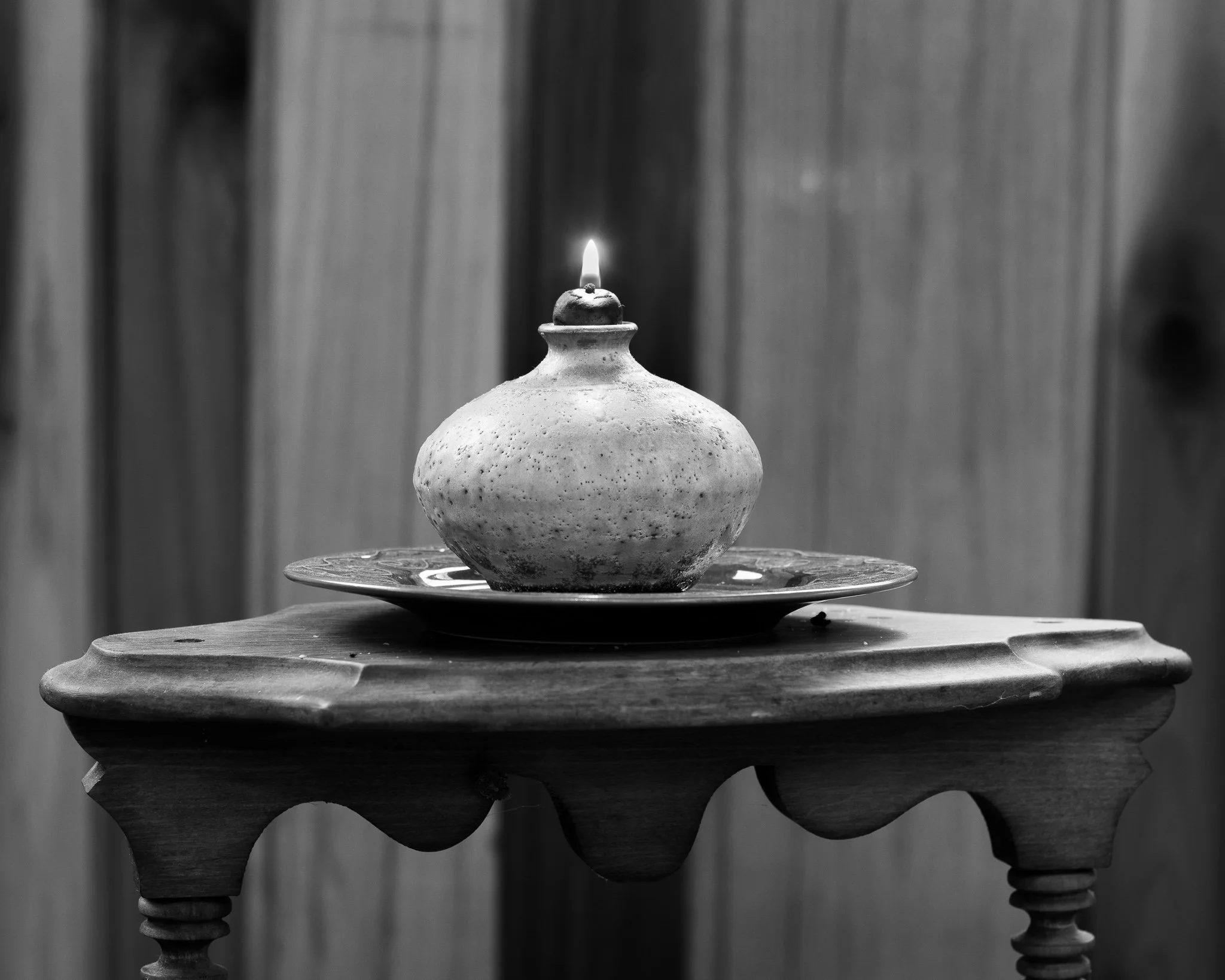
If you are my light, then shine on me.
I recently read Prayer Book for Earnest Christians: A Spiritually Rich Anabaptist Resource. It is a recent English translation of Die ernsthafte Christepflicht which was initially published in the early 1700s. It’s a fascinating insight into how at least some Anabaptists prayed. The language of the prayers feels more familiar to texts by earlier Catholic writers than any of my own Mennonite context.
Below is a portion of one of the prayers that I particularly liked.


Discipleship and Prayer: Following Jesus up the mountain

The concept of discipleship has been central to Anabaptist teach from its beginnings. For most of this history discipleship was spoken of as nachfolge German for to follow. Anabaptists emphasized Christ’s call to “follow him” and that following Christ should shape our lives and faith. This discipleship seemed to have largely ethical ramifications. Discussing ethics is the Anabaptist “happy place”. Following Jesus shaped how one was to relate to others with non-resistance/pacifism/non-violence being central to all relationships. (Unfortunately, we have seen that non-violence in relationships with women was not seen as important by some who emphasized discipleship.)
This approach to discipleship as shaping ethics is fine, but it is incomplete. Jesus life and ministry was not just about ethics. One place I can’t recall ever being taught to follow Jesus was up the mountain to pray. I’ve recently been rereading the gospels and have once again been struck by how often Jesus went away to be alone to pray. Mennonites have traditionally loved to follow Jesus into communities and crowds, but following Jesus into solitude up the mountain, or into the desert has not been seen as important part of discipleship.
It seems that one of the dangers of ethics being the central vision for discipleship is it quickly valorizes activity and effectiveness. Doing something is always better that doing “nothing” and quiet, prayerful solitude looks way too much like doing nothing. But this understanding is not faithful to following the Jesus of the Bible who yes, was very active and effective, but also repeatedly and regularly went up the mountain to pray, and regularly invited his disciples to follow him in this practice.
Stepping away from our good works to pray is necessary to place ourselves and our work in context of a fuller awareness of God’s presence in this world, and our humble and dependent reliance on God. Too often our work is a distraction from simply listening and being aware of God. Without this awareness our good works simply become our good works. Spending significant time going apart to pray helps our good work become God’s good work.
I could write a lot more about this than the little bit of meandering typing on this chilly Saturday morning. Image is from Maumeen pass in Ireland.

Farewell to The Hermitage

Today was my final day at The Hermitage. It was also our annual celebration of the Feast of the Transfiguration. These were my departing words.
Story –
‘A man was going down from Jerusalem to Jericho, and fell into the hands of robbers, who stripped him, beat him, and went away, leaving him half dead. Now by chance a priest was going down that road; and when he saw him, he passed by on the other side. So likewise a Levite, when he came to the place and saw him, passed by on the other side. But a Samaritan while travelling came near him; and when he saw him, he was moved with pity. He went to him and bandaged his wounds, having poured oil and wine on them. Then he put him on his own animal, brought him to an inn, and took care of him. The next day he took out two denarii, gave them to the innkeeper, and said, “Take care of him; and when I come back, I will repay you whatever more you spend.”
Many of you may have already heard of my interaction with this story, but months before June and I were set to join the Hermitage staff in a meeting with my spiritual direction supervisor he asked me what biblical image came to mind when I think of my spiritual direction. Never having given it any thought beforehand and emerging as a bit of a surprise, “the innkeeper in the parable of the good Samaritan” was what I said. This was undoubtedly the spirit moving within and preparing the soil for this next chapter of my life.
After this conversation I found a copy of a painting by Rembrandt of the Samaritan dropping off the injured man to the inn. This image has had a constant presence in my life since then. I would have a copy of it next to me when I provided online direction, and it has been on my office wall here at The Hermitage. And as all good biblical reading is a work of imaginative play, my own play with this story has expanded the story so that all the characters of this parable lodge at the inn. In this expanded version the priest is arrogant and entitled, the Levite is deeply anxious to not do the wrong thing, the Samaritan is the over working justice warrior trying to save the world, and the injured man is one of the invisible downtrodden. The innkeeper welcomes all who come, and all that they bring.
This image of the innkeeper, along with the writings of Brother Lawrence, the Rule of Benedict, and the example of Father William, the guest master at St. Gregory’s abbey have guided me as I’ve explored and developed my own identity as inn keeper here at The Hermitage.
Through these four years my work as innkeeper has been first and foremost to welcome all as Christ. I’ve also learned over the years that the primary thing I am welcoming people to or inviting people to, is to receive the gift of rest. While rest may seem like a trivial thing, like are we really doing all this just so people can take a nap? But we all come here, guests and staff with too much busyness and striving and anxiety racing around in our heads and bodies. To let go of all those things and receive the gift of a nap is truly a gift of resting in God’s care. I truly believe that in rest, in silence, in slowness we make ourselves available to God. A life in deep relationship with God is not a life of striving, but of receiving, not of accomplishing, but of allowing.
The season of Covid was (and is) a season of deep unrest. We were able to be open much of the time although often at a reduced capacity. It was heartbreaking for me to witness the deep exhaustion and trauma that people so visibly bore when they arrived on retreat. It was such a gift for me – who was often fighting that same exhaustion and trauma – to be able to welcome people to a place of deep rest.
With all my focus on me as innkeeper I do not want to give the impression that this offering of hospitality and running this organization was all my work, even if I sometimes had those delusions. If it had been all my work I would not have survived these past four years. This work has provided endless opportunities for community and collaboration with fellow community members David and Naomi, with staff Kim, Scott, and Ursula, volunteers, first and foremost Casey and many other, with the very supportive board, and with June. These partners in the work of the Hermitage have been an enormous gift to this place, and to me. Sadly, it is often in these closer relationships that extending the gift of gracious hospitality can be more challenging. I know that I have been every one of the good Samaritan parable characters to my colleagues and I’m unceasingly grateful for the compassion and grace they’ve extended to me.

My and Casey, my colleague for that past nearly two years, in our Hermitage Team/Magnificat t-shirts.
Story
About midway through my time at the Hermitage (in the midst of the season of Covid) I had a dream. I was driving an empty school bus and had to detour off the interstate into a city. Through a curious series of turns trying to figure out how to get out of this city the bus and I ended up in the middle of an airport terminal. I had no place to go so I stopped the bus. I exited the bus utterly confused and uncertain what to do. Then a gentleman in overalls came towards me, he lightly grabbed my elbow and with a gentle laugh led me on for us to figure out how to get me out of this predicament. When I woke up, I immediately new that this dream was significant.
Naturally, this dream became fodder for a few sessions with my spiritual director. It seemed to make sense to me that the bus was obviously the Hermitage, a large vessel I was trying to maneuver through unknown waters – to mix my metaphors. But if that was the case, I was troubled that the dream ended with me walking away from the bus. While I was grateful for the man helping me abandoning the bus felt like a betrayal.
The part of this dream that has particularly stayed with me is the gift of the stranger’s reassuring laugh and quiet invitation to go along with him. It was an act of generous hospitality to a weary pilgrim. My third story is actually a poem, in which we will again encounter that gentle laugh.
Story – Poem
The Guest House by Rumi
This being human is a guest house.
Every morning a new arrival.
A joy, a depression, a meanness,
some momentary awareness comes
as an unexpected visitor.
Welcome and entertain them all!
Even if they’re a crowd of sorrows,
who violently sweep your house
empty of its furniture,
still, treat each guest honorably.
He may be clearing you out
for some new delight.
The dark thought, the shame, the malice,
meet them at the door laughing,
and invite them in.
Be grateful for whoever comes,
because each has been sent
as a guide from beyond.
As I leave the Hermitage I wonder what to make of my innkeeper identity when I have no inn to keep. This Rumi poem is a wonderful reminder and encouragement for me that this work of inn keeping is not just about providing a physical space for people, although that is incredibly important, but at it’s core it is about a willingness to welcome others, welcome God, and to welcome the fullness of ourselves into our own hearts. And as with the figure in my dream we hear with Rumi the act of welcoming comes with a gentle laugh and an invitation in.
And so now what is next for June and I. We have one more week of packing and cleaning before we move to Winkler, Manitoba, Canada. For me, this move will be my return to Canada, and my hometown of Winkler after a 30 year absence. The primary reason for this move to is be close to my folks as they age and to be available to them in this time. I’m currently looking for work that is in some kind of alignment with the idea of the innkeeper, which will most likely be with an organization that works with developmentally disabled adults. June will remain retired and has already signed up for her first quilting retreat at the end of August.
May the Hermitage, and all who care for her continue to be blessed with a spirit of gentle and jovial hospitality, welcoming all as Christ.

Mennonite Seeds of Contemplation
I recently had two wonderful conversations with John Rempel, a Mennonite scholar and former pastor. He was on retreat at the Hermitage therefore was a captive audience when I first begged a bit of his time for a conversation. What I wanted to talk with him and hear from him was about the state of Mennonite spirituality today, and if there was a place for contemplative spirituality within contemporary Mennonite spirituality. It was an engaging conversation. On his last day of retreat, he requested a follow-up conversation.
One of the primary take-aways for me from these conversations is the conviction that there are seeds of contemplative spirituality within, or indigenous to Mennonite spirituality. This conviction leads to the questions of are how are these seeds nurtured, and who is nurturing them?
We noticed that one of these seeds that had been nurtured was a movement towards a broadening and deepening of expression of Mennonite spirituality in the late 20th century. At the center of that movement was Marcus Smucker and Marlene Kropf at Anabaptist Mennonite Biblical Seminary; then Associated Mennonite Biblical Seminary(ies). These two, with institutional support, created a strong academic and pastoral base to think more deeply about spiritual practices and study within the larger Mennonite church. When both of these people retired, the momentum they created was not taken up by any institution. Without an institutional home the movement waned. This is a loss, arguably a tragic loss. Perhaps, this is also an opportunity.
One of the other seeds of contemplative Mennonite spirituality that was nurtured during this late 20th century was the Hermitage – the retreat center I now direct in southern Michigan. The Hermitage was formed by Gene and Mary Herr and a community of supporters. The Herrs had been deeply formed by and involved with the Mennonite Church and while not officially supported by the denomination, the Hermitage was seen as a Mennonite center exploring contemplative spirituality. While we are still exploring contemplative spirituality, the Mennonite-ness of this place has also waned. While this may be the natural ebb and flow of systems, it too is a loss.
I know my awareness of broader contemporary Mennonite spirituality is limited but I think the loss of an institutional home, or center for contemporary Mennonite spirituality is a critical loss. I know there are a lot of Mennonite individuals and churches interested in and engaging in contemplative spirituality, but without collaborative discussion and institutional support, it will likely remain as scattered little cells.
I will have more conversations with others about Mennonite seeds of contemplation. I hope these will uncover new seeds and new understandings of a contemplative Mennonite spirituality.

Faulty vision
I started wearing glasses in 5th grade. The frames were hand-me-downs from my brother.

During the next 44 years I’ve endured ever thicker, heavier glass lenses, and then lighter plastic, progressive lenses correcting poor sight both near and far off.
And yet, despite almost yearly recent changes in my lenses I find my vision to be worsening. The only instance when I have good focus is when my face is 6 inches from what I’m looking at, and I remove my glasses. Otherwise, everything has some level of blur. It’s not just blur that’s the problem. Seeing in shadows and dim light is increasingly difficult. Dark cars without lit headlights can easily be missed. Bright light outside turns most things into silhouettes.
My vision has taken a noticeable turn for the worse in the last few years. Curiously, these are also the years when my interest in photography has increased.
I used to do most of my photography outside but as my own ability to focus and recognize what is in the shadows has decreased my joy with outdoor photography has diminished. My camera and I see things quite differently. I have little idea how a shot worked until I get home, transfer it to my computer, and look at it with my glasses off and my face pushed toward the screen.
I have spent more time doing photography in my studio/cell. I prefer to do this in the evening when the light is low. I begin by removing my glasses. In this environment, where light and movement are controlled, I can peer at the display on my camera and actually see what it is seeing.
Even though doing this type of photography is an accommodation to my poor vision, it has also become good for my soul. It is an intimate and contemplative way of doing photography. I’m able to focus on details that I never could otherwise. As I’ve added macro capability to my photography, I find myself exploring what I’ve called “fantastical landscapes” discovering and creating what feel like landscape scenes from a unknown places. This is becoming an opportunity for some deeper explorations.


I have an appointment in March for an evaluation to see if I qualify for insurance-covered cataract surgery. I am excited by this prospect. It is an interesting experience to go through life with this vision challenge, and I recognize the creative challenge of working within limitations. I wonder if being able to see clearly will be jarring for me. I wonder if there is something about the world I see with this faulty vision that I will miss. That may be but being able to read regular print and see cars driving toward me will be good.
The Gift of Rest
“Therefore, my heart is glad, and my soul rejoices; my body also rests secure, (Ps 16:9)”
Some years ago, June and I volunteered at The Hermitage while David and Naomi Wenger were on sabbatical. Upon their return I approached David and asked him, “Did you receive in faith the gift of rest?”
This may seem like a curious question, and I’m sure I was attempting to be clever, but the words of this question were familiar to David. The words, adapted from Matthew 11, come from The Hermitage Affirmation, the morning prayer liturgy drafted by The Hermitage founder Gene Herr which we pray on Mondays.
Teach us, Jesus,
to hear you,
to come with the heavy loads we feel, to be yoked with you,
to be taught by you,
To learn what things really matter, and to receive in faith the gift of rest.
Today, as director of The Hermitage, I feel I am beginning to glimpse the powerful reality of the gift of rest. This season of Covid has brought many weary and exhausted people to our doors. Their presence with us and their experience of The Hermitage has taught me about receiving the gift of rest.
I confess that in the past I thought of rest as synonymous with relaxation. Rest was a pleasant, if at times, an irresponsible luxury. Rest could easily become a distraction from responsibility and productivity. Rest was good if you were tired, but too much resting was a sign of laziness.
In my quick orientation with new guests, I always point out the chapel and how we gather for morning prayer at 8am. I then add that guests are welcome to join us and are welcome to sleep as both sleep and rest are deeply important parts of retreat.
Rest is a practice and a gift.
Rest is a product of letting go of the need to shape each moment of our day; letting go of ambitions and anxieties; letting go of finding our value in our productivity; letting go of our sense of how indispensable we are.
In his life of ministry, and his training of the disciples, Jesus emphasized rest. “He said to them, ‘Come away to a deserted place all by yourselves and rest a while.’ For many were coming and going, and they had no leisure even to eat,” (Mark 6:31).
Choosing to practice the spiritual discipline of rest can be very difficult for some of us. It certainly is for me. I find it hard to practice rest because it is difficult for me to accept that, somehow, The Hermitage could survive a day or even a week without my near constant attention. This is foolishness.
Rest can come with feelings of guilt for all the work others have to do for me to rest. Rest can cause us to question our self-worth. “What if I rest from work for a few days and nobody notices?”
Rest is intimately related to trust. Without trust rest is elusive. In order to rest we must trust that life will be okay without us being useful. We must trust the emails and texts that go unanswered while on retreat will still be there when we return and that many of their “urgent” problems will have already resolved themselves. Rest also comes when we can trust food will be available when we are hungry, and a warm bed will be available when tired. We rest in the arms of the ones we love, because we trust them.
As we see in Matthew 11, we are to come to God and give God our weariness and business, and in turn, God will give us rest. The goal of our journey is to rest in the heart of God, the most trustworthy One.
“Did you receive in faith the gift of rest?” I asked of David upon his return from sabbatical. David laughed at my question. “Have I received in faith the gift of rest?” he slowly repeated. After a pause he replied “Why yes! Yes I have.”
This article originally appeared in the Hermitage newsletter and blog.


Thanksgiving in South Haven
The wife and I are spending a couple days over Thanksgiving in South Haven. Naturally, I needed to do some lakeside photography.


Silence: quotes from Clarence Bauman
As I consider what the contemplative Mennonite world might look like I pulled my copy of “On The Meaning of Life” by Clarence Bauman. Bauman was a Mennonite theologian, philosopher, and mystic who taught at Anabaptist Mennonite Biblical Seminary. He and his wife Alice regularly hosted silent meetings at their home on the edge of campus. He passed away while I was a student and I don’t recall having the chance to meet him, but did get to know Alice. More information about Bauman can be found on his GAMEO entry.
The video includes several quotes on silence from Bauman’s book.

Contemplation: a Mennonite Perspective
I am Mennonite and I am contemplative. I co-direct The Hermitage, a contemplative retreat center with Mennonite ties. I know of many others who consider themselves both Mennonite and contemplative and I am sure there are many others I don’t know of.
What I am not sure of, however, is what the Mennonite contemplative conversation sounds like. I am not aware of much public discourse on what it looks like to be a contemplative Mennonite. I don’t exactly know how being Mennonite impacts being contemplative. But, surely it must.
Christian contemplative spirituality has many traditions. I’d be hard pressed to identify a Mennonite contemplative spirituality tradition. What are the practices of a contemplative Mennonite?
And so, I’d like to delve deeper and listen to this conversation. I’m less interested in proposing what contemplative Mennonite spirituality could look like, than I am in discovering what it already looks like. I’m also less interested in what historians have to say with so many words about early Anabaptist spirituality than I am in seeing how these themes are finding contemplative expression amongst Mennonites today.
Some of this little quest for understanding begins with myself, and with The Hermitage which has welcomed and formed many contemplative Mennonites. Some of this quest will likely involve hearing the reflections of others on their own contemplative Mennonite spirituality.
This has the potential to be a large quest, and I’m cautious about how far or fast I can go. The way is made by walking, so I guess I should put on some shoes.
*FYI - the image at the top is an altered image of the current “Confession of Faith in a Mennonite Perspective”