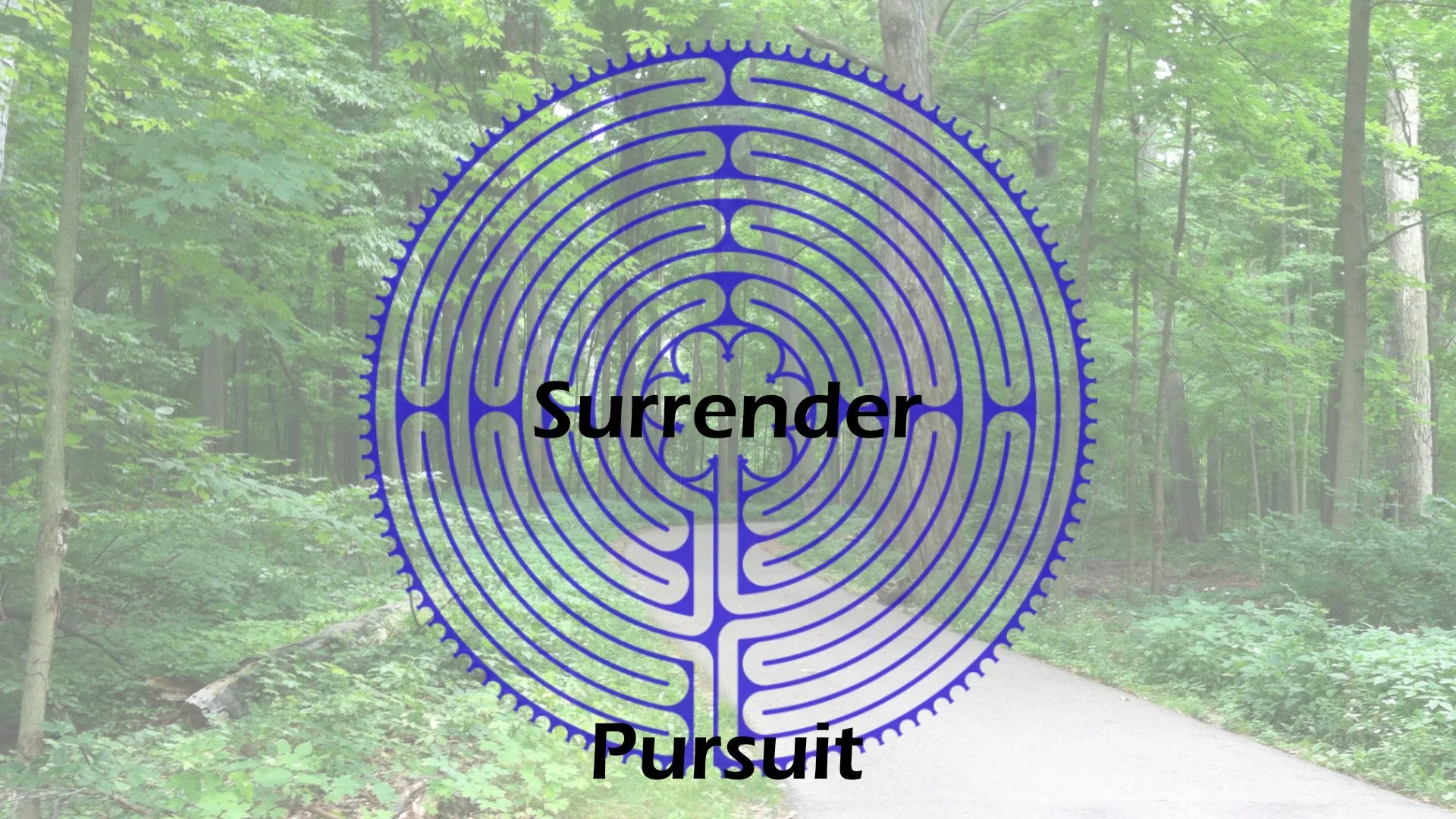
Pursuit to Surrender
“I was dull, obtuse, stupid as an ox. But I stayed close to you, and you took my hand. ”
This pair of verses on the screen in this version from the Psalms is one of my favourite scripture texts. We’ll come back to this text but I do I see it as a bit of a summary of the journey in faith I’m going to share.
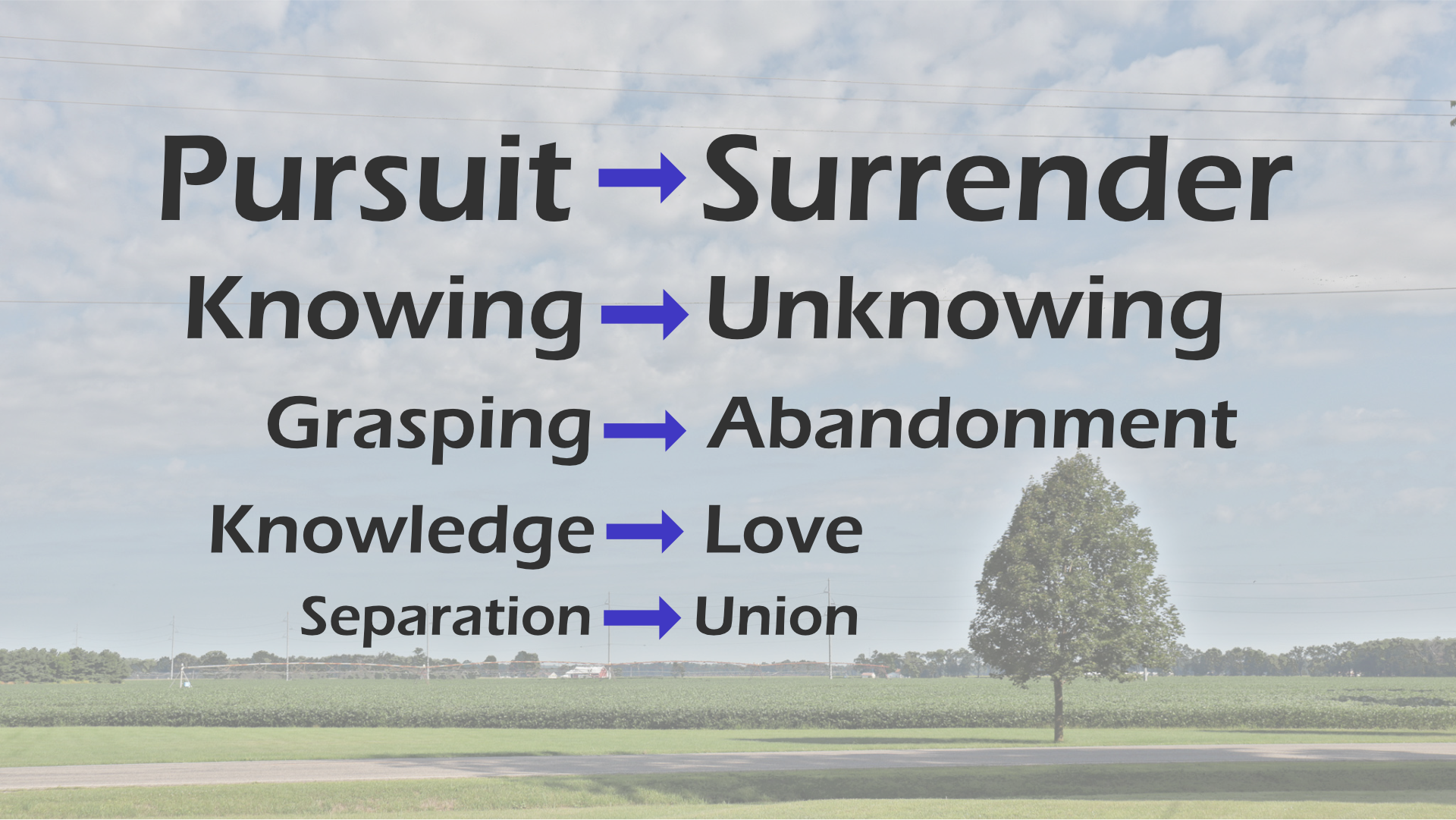
I’ve called my talk this morning “Pursuit to Surrender” which could be a talk about current US foreign policy but is rather, a talk about my spiritual journey. As you can see, I’ve given it a few optional titles, “Knowing to Unknowing”, “Grasping to Abandonment”, “Knowledge to Love”, and “Separation to Union.” The ideas in those alternative titles will appear in my talk, but I will begin with pursuit to surrender.
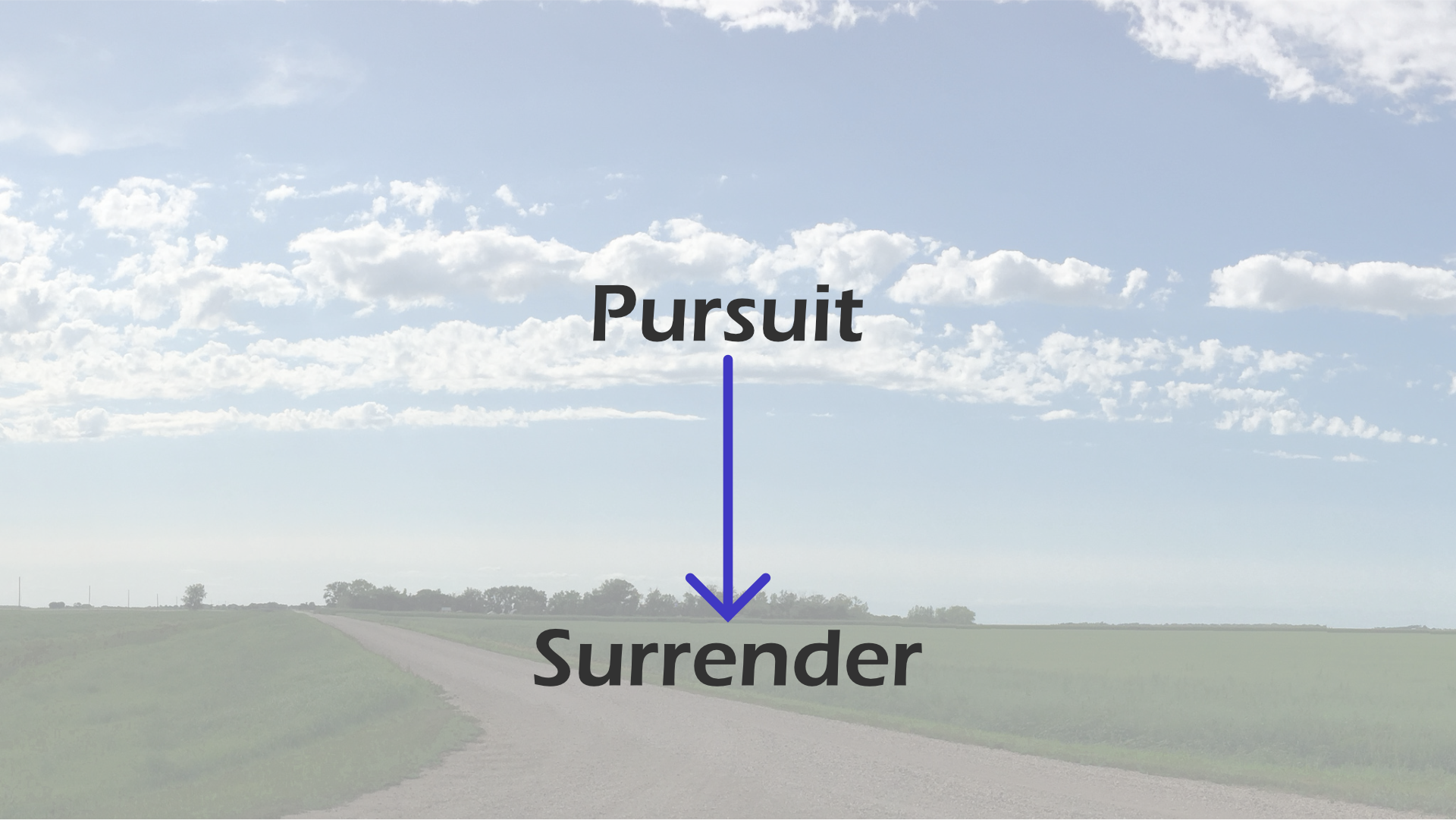
Now a journey usually entails moving from one place to another implying you leave one thing behind to get to the next thing. From point A to point B. But that doesn’t feel like my journey at all.
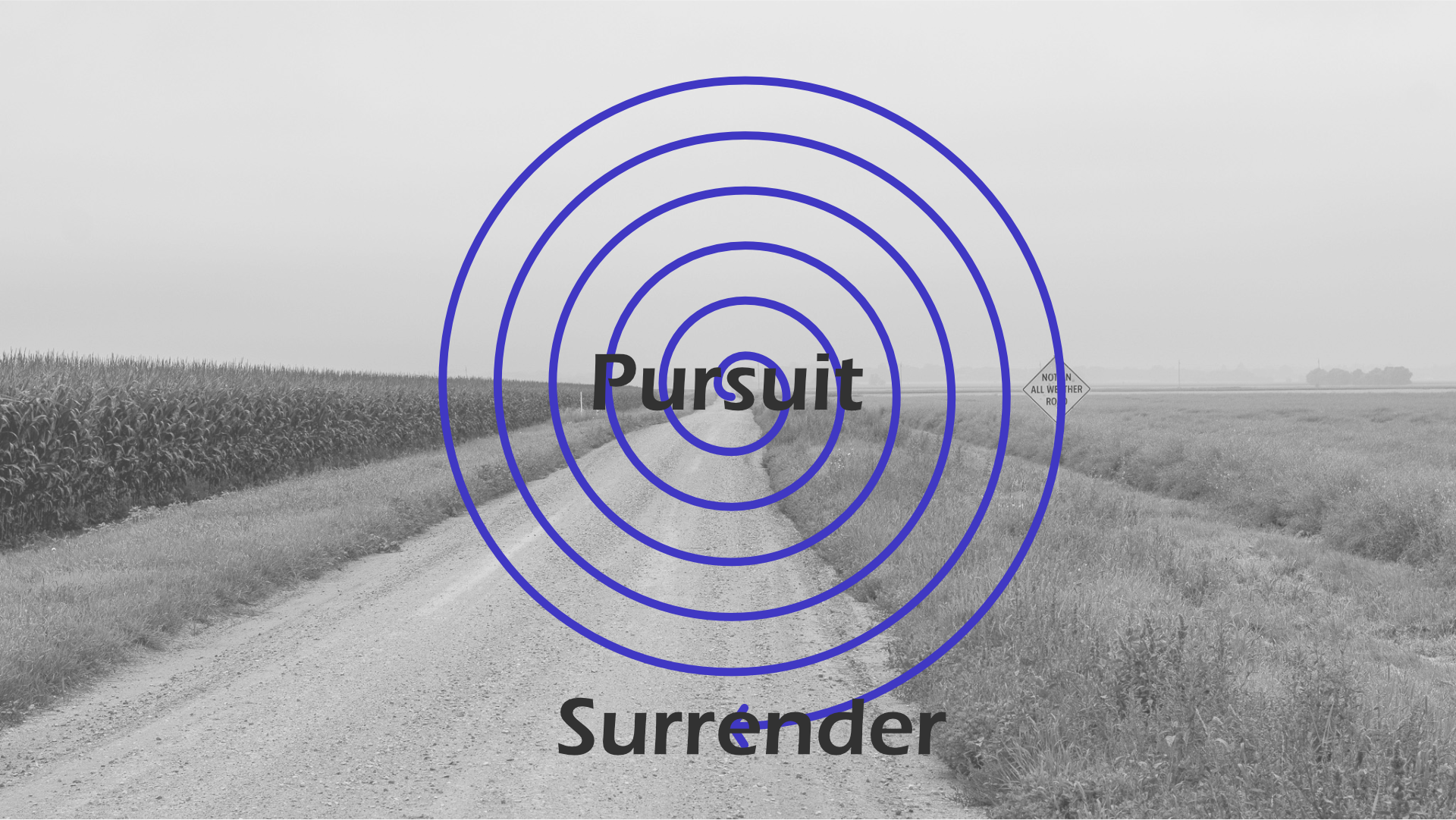
I think the spiral may a better depiction of this journey. What I like about the spiral is it isn’t about moving from one point to another but about being in the tension between these opposing forces. The center point of the spiral, pursuit, is the gravitational draw pulling me back and keeping me from flying off into space. The other energy of the spiral is movement pulling me further and further out, but never beyond the pull of gravity. The gravity gets weaker the farther you go, but it is still shaping your movement.
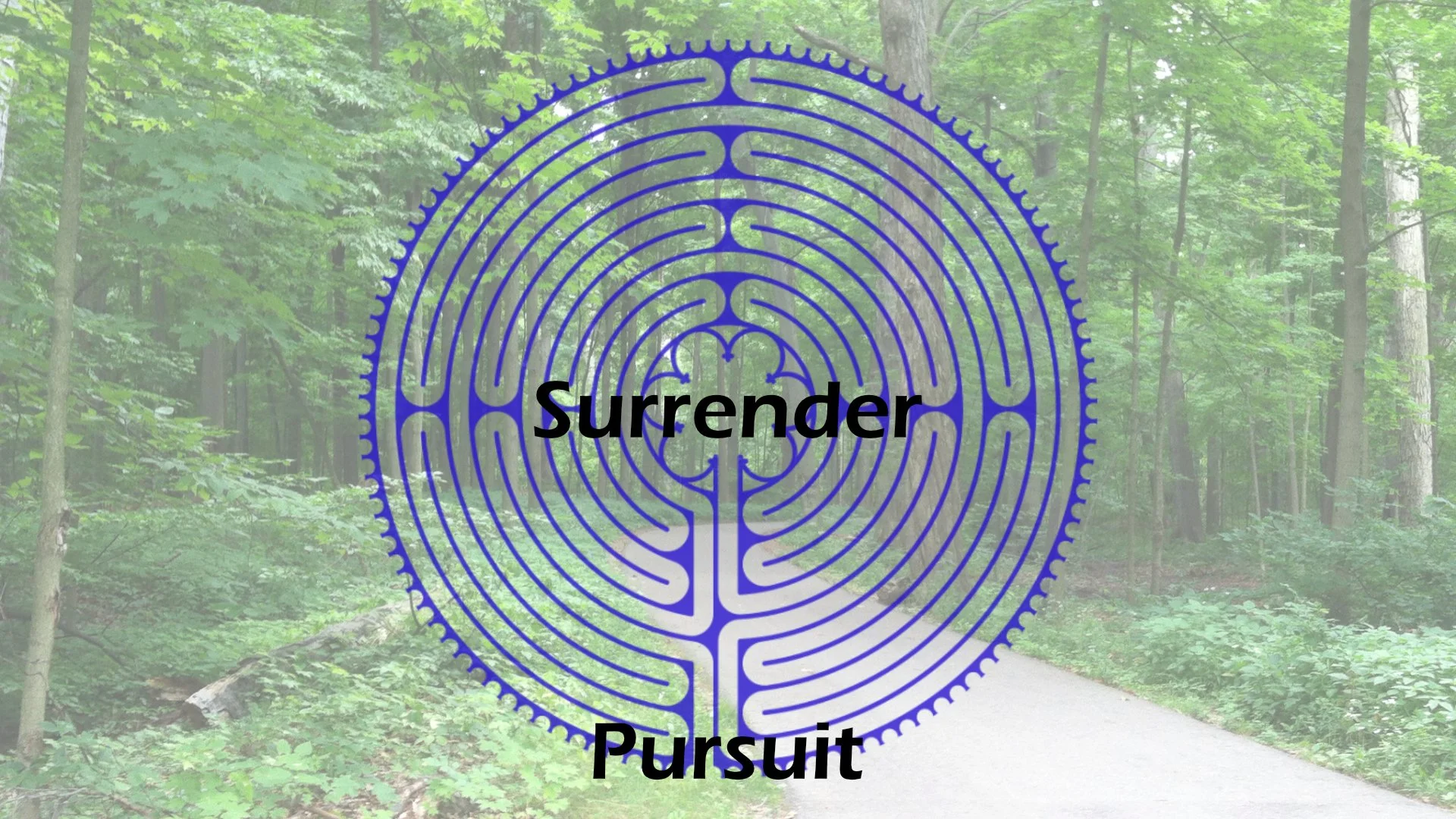
Perhaps the journey looks more like a labyrinth. There is only one path in, but at times in the journey you are closer to the centre and at times further away and the best that you can do is rest in the way set before you. Honestly, there are all sorts of different ways to depict this journey, and none are perfect.
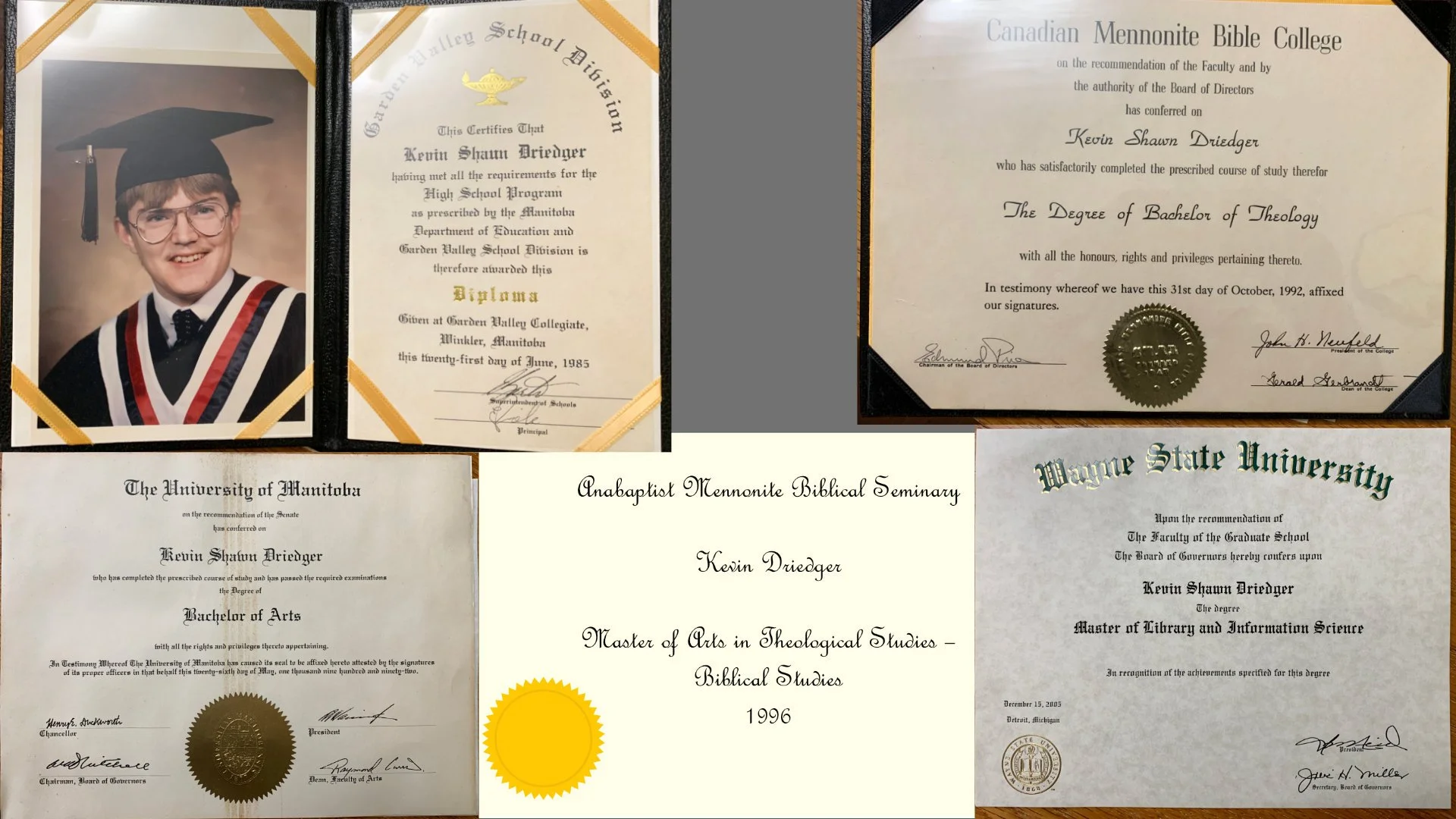
This is my high school diploma from Garden Valley Collegiate, and my Bachelor of Theology from CMBC, and my Bachelor of Arts (religion major and anthropology minor) from the University of Manitoba, and I seem to have misplaced a diploma, but I received a Master of Arts in Theological Studies – with a focus in Biblical Studies from Anabaptist Mennonite Biblical Seminary, and finally, a Master of Library and Information Science from Wayne State University. And yes, I have in the past considered doing a PhD, but never very seriously.
As is evident from all these diplomas, I’ve spent a good portion of my life pursing knowledge in a formal, structured way within academic disciplines. I’ve also spent a good deal of my life pursuing knowledge in less structured and more personalized ways. This pursuit has been and continues to be a joyful and exciting part of my life and has made me who I am today. Who doesn’t like learning new things and understanding new ideas? Knowing about gravitation and centrifugal forces helps me understand spirals which helps me create a model to understand my spiritual growth.
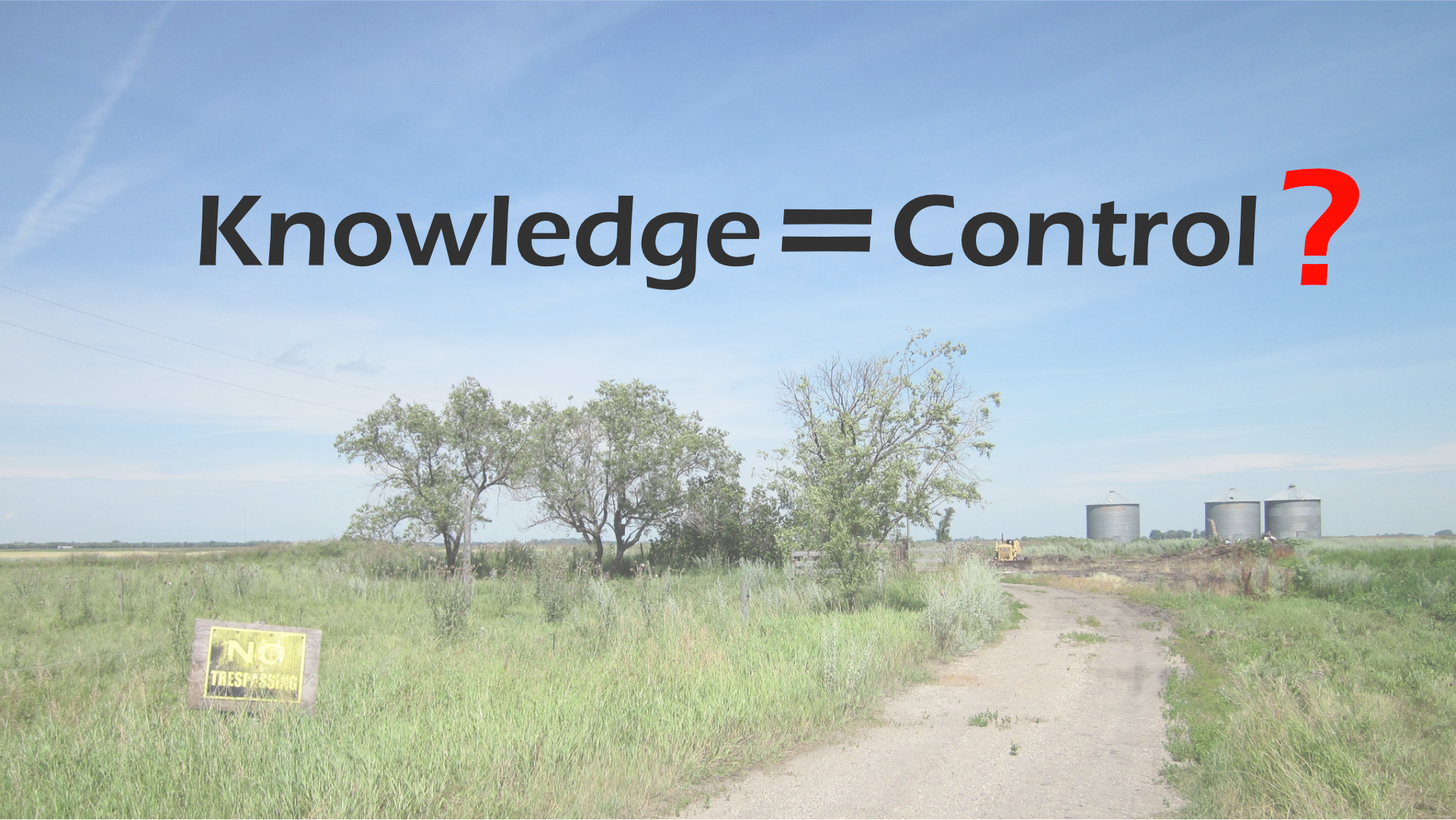
We humans have a natural urge to understand, define, and secure our world. The pursuit of knowledge is about understanding and making meaning of our life and existence. Life and reality are much easier to deal with when we have a way of understanding them. Explaining issues of life and faith make life and faith manageable and under control. We don’t like chaos. We don’t like things happening for no reason. We long for certainty. We long for control.
Our modern scientific worldview has given us a prescribed framework or lens with which to look at the world and make meaning of the world. In this worldview everything that exists must be measurable (more or less) it must exist in some material manifestation. What exists are me, and the other things or objects that are not me. We are separate. Everything that is not me, including God, is an object to be studies and understood. This understanding has shaped our modern, largely protestant faith, and shaped our understanding of God.
This worldview which shapes all part of western life, and which I have absorbed and live with. It is all fine and good, but it just doesn’t feel complete. It’s like me trying to find a visual model to depict my spiritual journal. Each one is accurate, but not complete. This worldview, built on objectivity where everything is separate from everything else fosters a sense of isolation and anxiety.
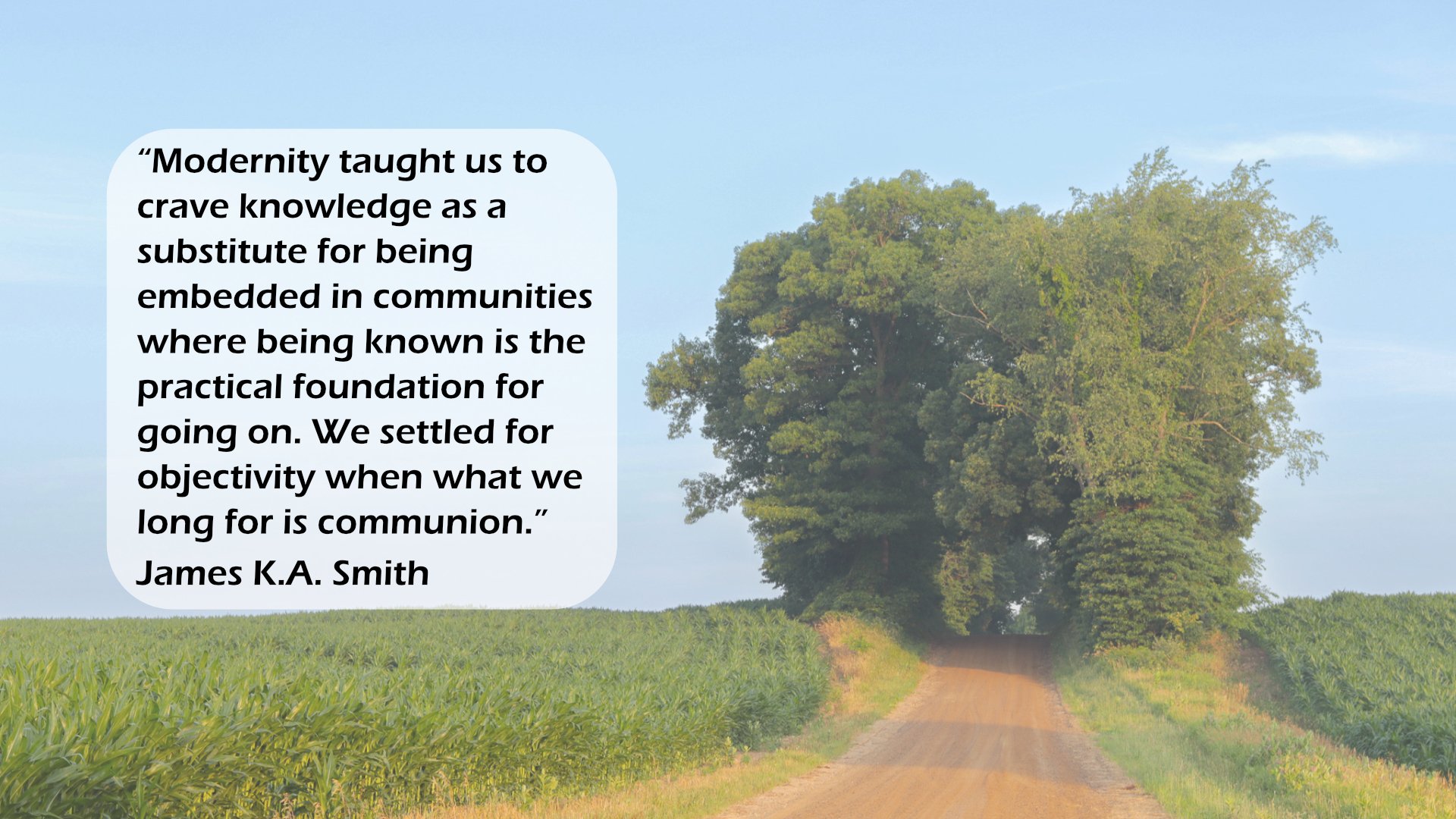
It was in seminary where knowledge started becoming more of a heart or soul thing. My professors were highly trained, well-regarded academics, and the courses were rigorous, but the professors also modelled knowledge expressed in worship and prayer. The emphasis was both on academic rigour and spiritual formation not as parallel tracks, but as interdependent approaches. Seminary was also a place where my understanding of and experience with more contemplative approaches to faith began to grow.

After finishing there I eventually entered an into ever-more meaningful relationship with the oft-mentioned contemplative retreat centre, (The Hermitage) a growing connection to contemplative practices, spiritual direction, and spending more time and thought with early, and current Christian mystics and their writings.
This journey of mine began to reshape my relationship with and perspective on God. The closer we come to God, the more we discover that God is not an object we can possess. I’ve become increasingly attached to the image of Job and his relationship with God immediately after his ordeal is complete and he has face God’s fierce and lengthy interrogation. “Where were you when I laid the foundation of the world?”
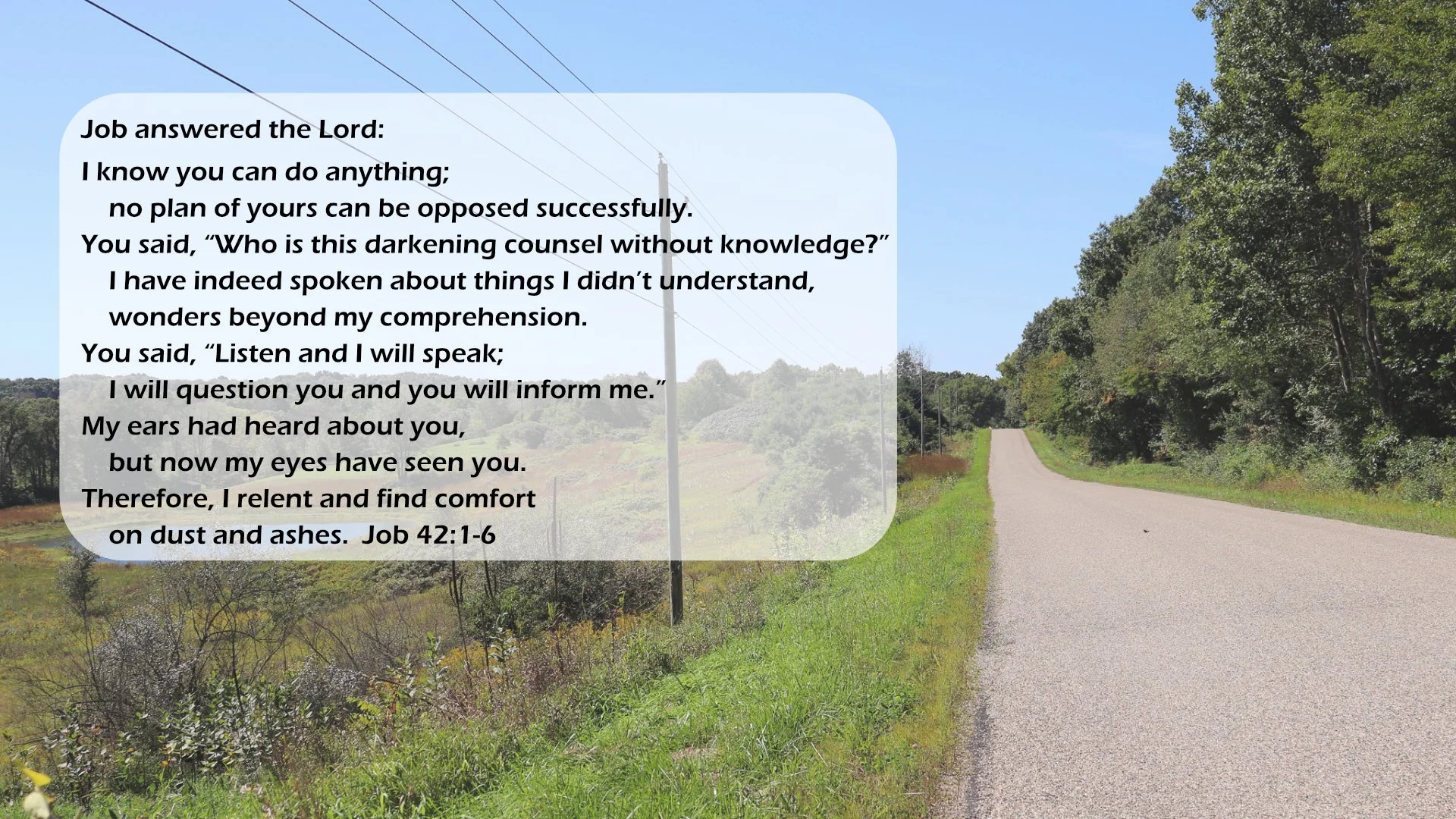
“I have indeed spoken about things I didn’t understand, wonders beyond my comprehension. There I relent and find comfort on dust and ashes.” Job teaches me that God is God, and God will do what God will do. This isn’t an excuse for a capricious God. I’m not saying aspects of Job aren’t challenging. But it is a reminder not to make God too small, and reasonable, and understandable. Our relationship with God is not a relationship of peers, but of creator with created.
As we dive deeper into scriptures, we see that knowing about God/knowing God is often depicted not as something achieved by the searcher but as a revelation gifted by God
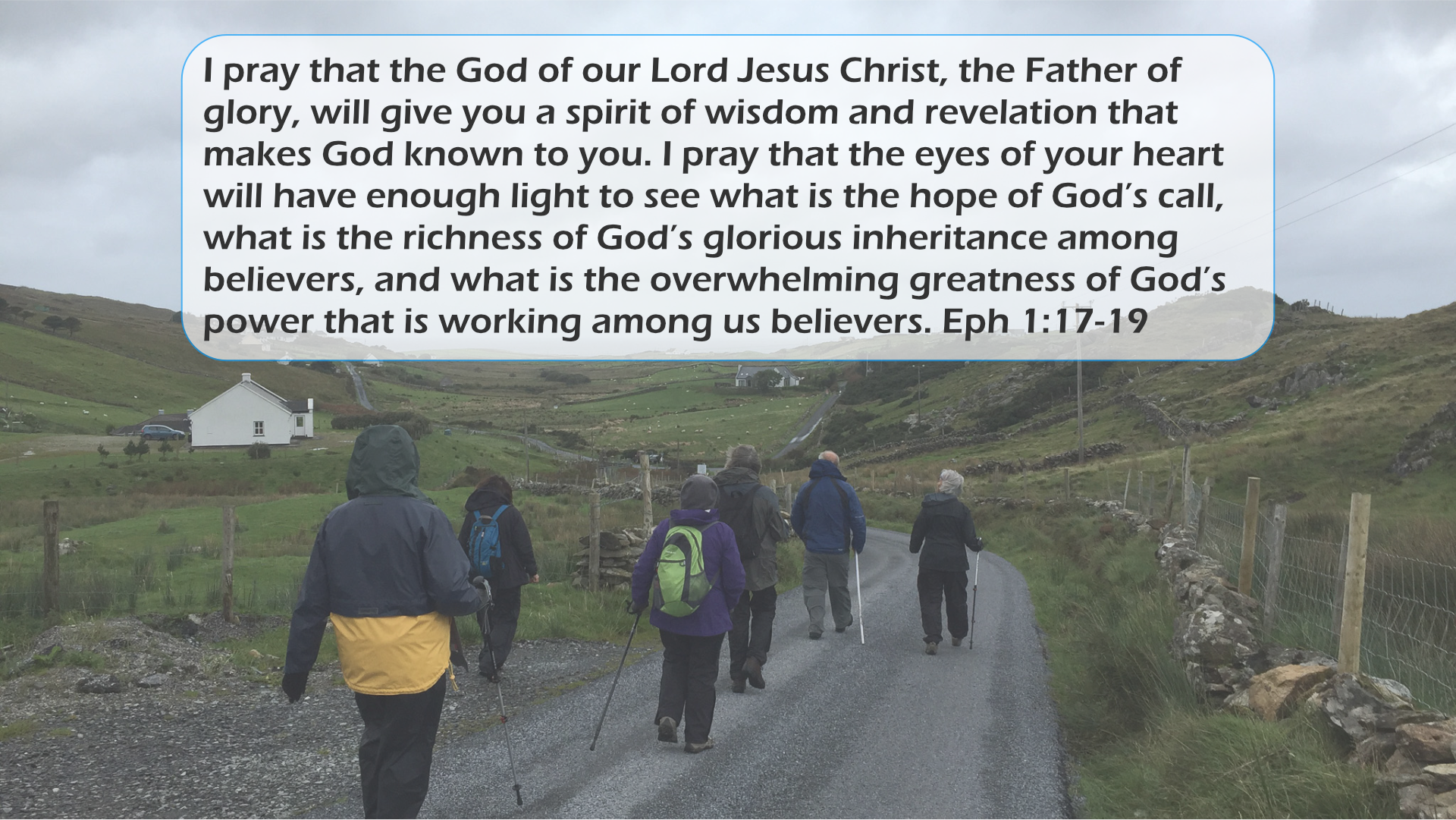
I am very aware that my thoughts and my mind are much too limited to comprehend all that is. If everything is ultimately explainable to the human mind, as the western scientific worldview believes, we live in a very tiny universe. But mostly I’m aware of the limitations of my understanding or conception of God. Any thoughts I have about God are simple thoughts that try to make the unknowable and uncontrollable knowable and controllable. Pursuing knowledge about God can only go so far. Beyond that we move into the Cloud of Unknowing.

The Cloud of Unknowing is a book written by an anonymous British monk in the 14th century. It is about when the Christian life goes so deep it moves beyond our ability to understand or know. The Cloud of Unknowing is that place beyond intellect where God is encountered by blind love. To get here, according to the author, we go through the Cloud of Forgetting where we forget all past memories and conceptions about God. We leave our past notions of God behind and approach God with nothing but love.
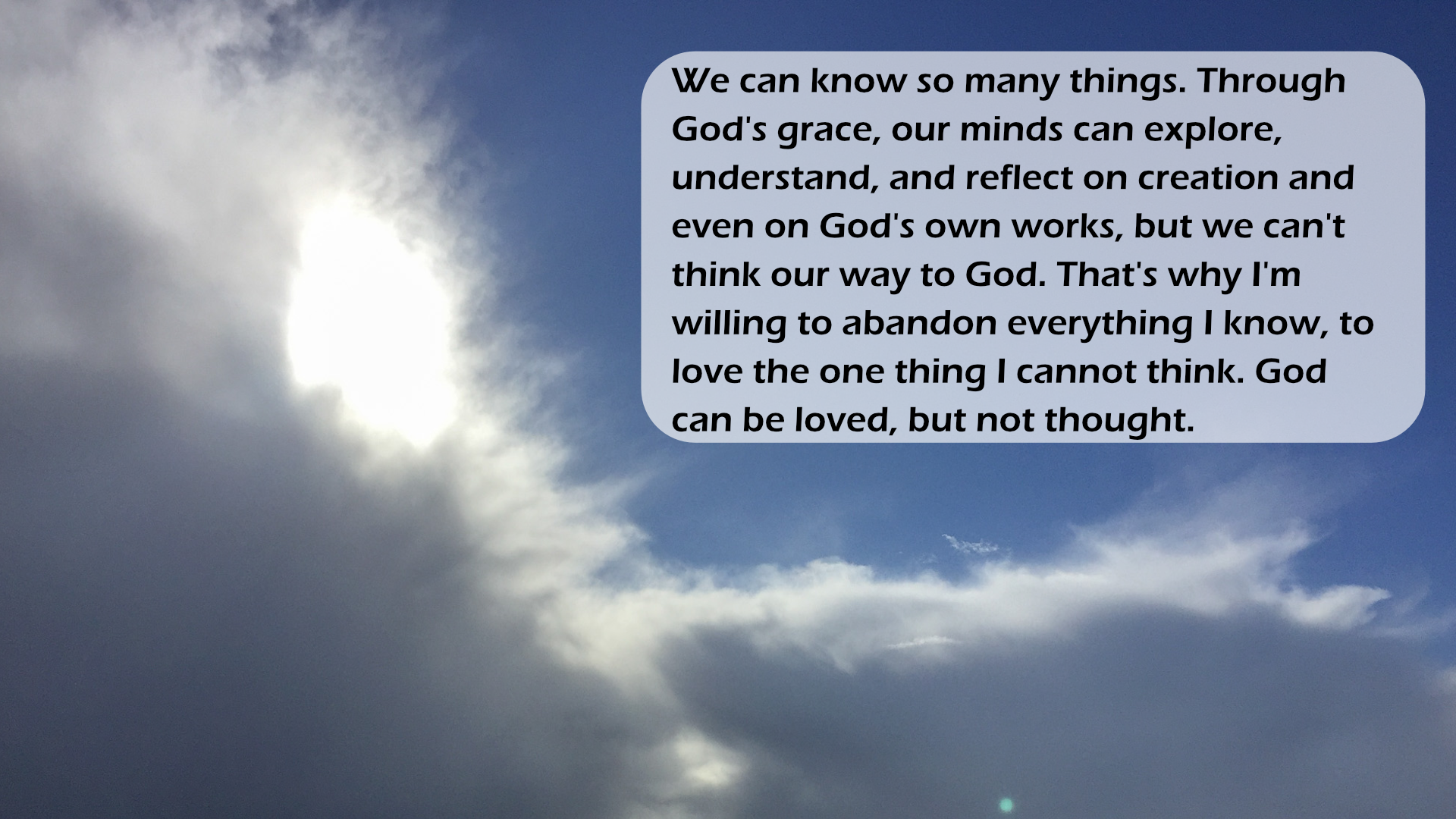
The goal is not simply knowing God, but union with God. It becomes not something we pursue, but something we yield to, surrender to, receive. As modern mystic Martin Laird wrote “Union with God is not something that needs to be acquired but realized.”
I find language or words about God increasingly insufficient. As the early Christian mystic Pseudo-Dionysius wrote “Thus now, as we plunge into the darkness beyond all understanding, we shall encounter not only brevity of speech but complete wordlessness and lack of understanding.” We say God is love. But God’s love is beyond what we can conceive of as love. I’m more content with saying “God is God, and we are not”, or “God is God and we are loved”.
From pursuing God, we move to a stance that looks more like surrendering to God. This approach looks like Mary’s “Let it be with me according to your word.”
While this all may seem very foreign to our Mennonite ears and just seem like Kevin going on another Catholic trip, a relevant word or concept that has been significant in Anabaptist history is the word “gelassenheit”.

An approximate English translation is yieldedness, and it is closely associated with humility and meekness. It describes a selfless, self-denying approach submitting ourselves to the will of God, the church, and others. For modern Anabaptist groups like the Hutterites, this submission is exercise in giving up private possessions. This gelassenheit is a stance of yielding my self-will and my ego to what is beyond me.
While this language of gelassenheit, or yielding, or surrender can seem challenging to modern sense of agency and self-empowerment – and everything has the potential for abuse – in it’s best sense these words direct us to a life of complete openness to God and God’s will in whatever way God comes to us.
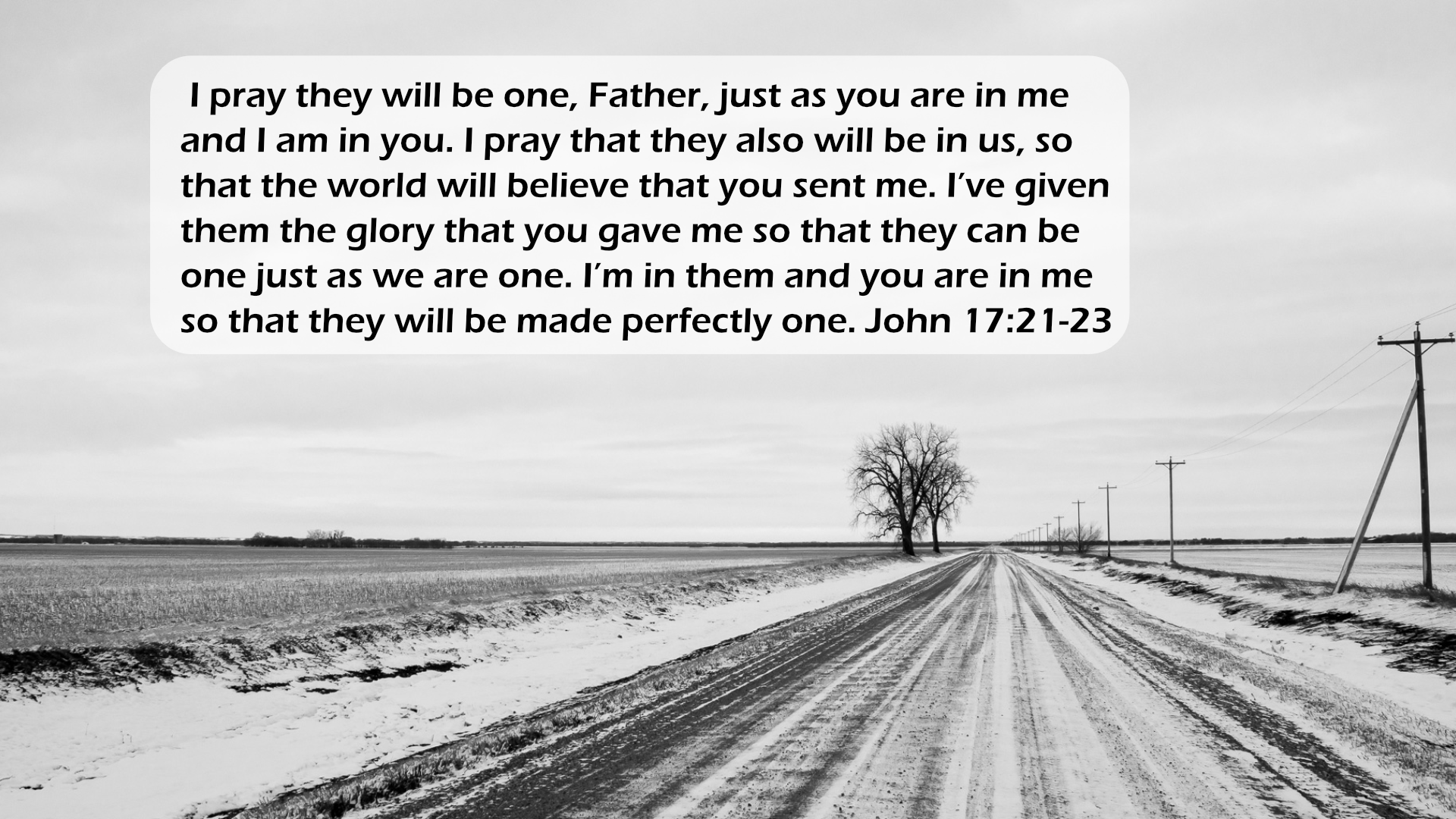
This life depicted in Jesus’ prayer for his disciples in John 17.
As I mentioned at the beginning of this sermon one of my various titles this is a move from Grasping onto God to Abandonment into God.
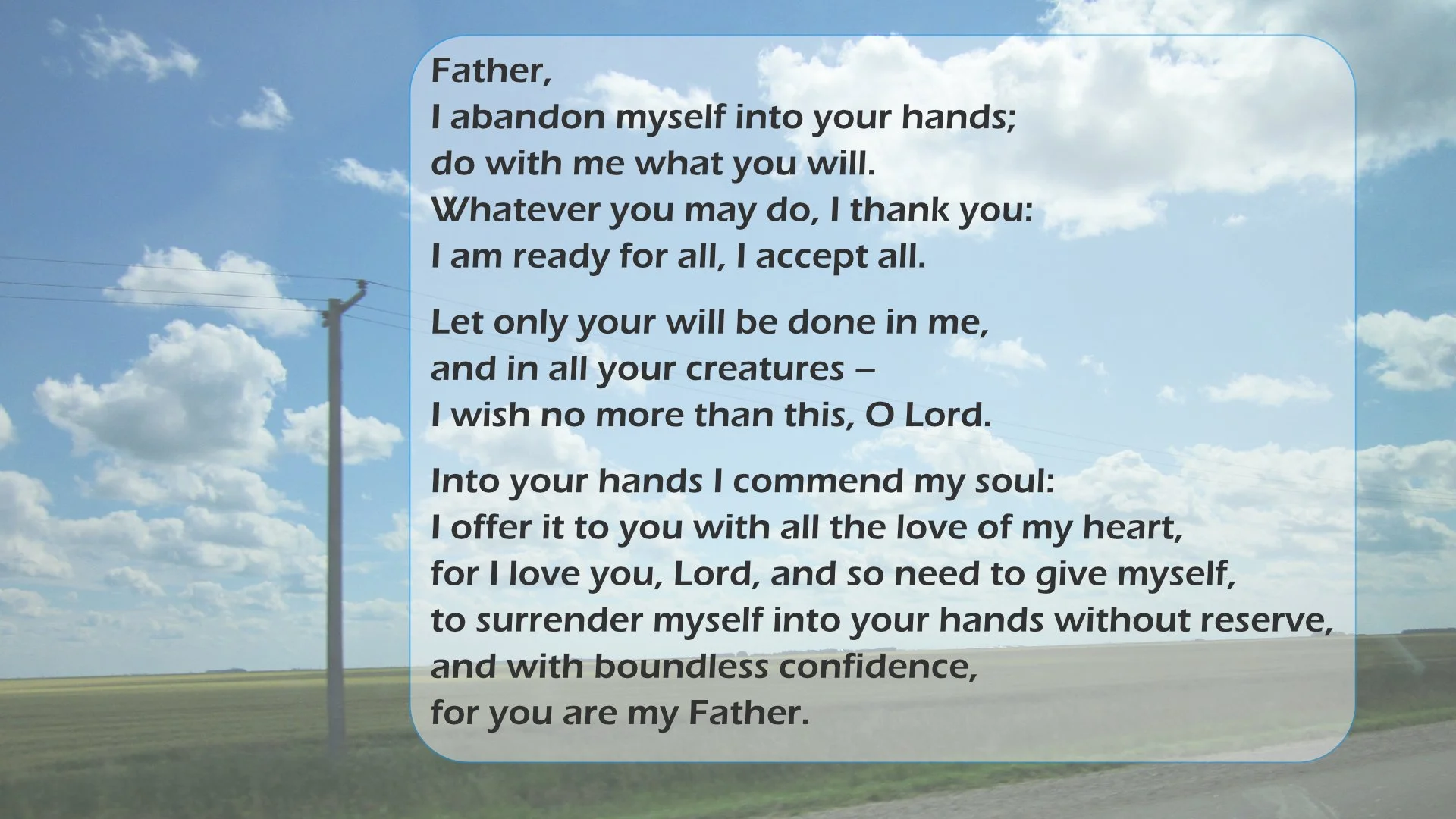
This brings me to the wonderful and powerful prayer of Abandonment by Charles de Foucauld. Granted it does stick with traditional paternal imagery for God. This could just as well be prayed to Mother God.
What does this curious journey into unknowing and gelassenheit have to say to our church today? As we as a congregation look ahead, and especially as we talk about size, growth, and vision, I pray that we don’t just strive and pursue a goal thinking that if we just do X, Y, or Z then we will get the results we want. Or that if only we work hard enough then things will change for the better. I pray that we remember that God is God and we are God’s children, and this is God’s church. We need to also remember to be attentive to, and yield with trust to the work God is doing in our midst, even if we are unsure what that work is. And know that we have no idea how things will turn out, but if we stay close to God, God will hold our hand.

Come away to a deserted place all by yourselves and rest a while

Sermon based on Mark 6:30-44 delivered on March 2, 2025.
Take a few deep breaths. Inhale deeply, hold for a moment, and exhale. Do this a few times.
According to Google’s AI “Deep breathing can have a significant positive effect on your body by reducing stress, lowering blood pressure, calming the nervous system, improving focus, and promoting relaxation by sending signals to the brain to trigger a relaxation response, making it a valuable tool for managing stress and anxiety.” Deep breathing can provide a sense of rest.
And now I want you to take a moment to consider what do you need to feel at rest? Is there a particular place that comes to mind? Are there particular sounds or music that creates a sense of rest for you? Is there a particular time of day? What makes you feel at rest?
‘Come away to a deserted place all by yourselves and rest a while.’
Some years ago, before we worked at The Hermitage, the contemplative retreat center in Michigan, June and I volunteered there while David and Naomi, then the directors, were on sabbatical. Upon their return I approached David and asked “Did you receive in faith the gift of rest?”
This may seem like a curious question, and I’m sure I was attempting to be a clever, but the words of this question were familiar to David. The words, adapted from Matthew 11:28-30
‘Come to me, all you that are weary and are carrying heavy burdens, and I will give you rest. 29Take my yoke upon you and learn from me; for I am gentle and humble in heart, and you will find rest for your souls. 30For my yoke is easy, and my burden is light.’
We used an adaptation of these once a week when we used the Hermitage Affirmation, a morning prayer liturgy drafted by Hermitage founder Gene Herr and still used each week. The words we prayed read:
Teach us, Jesus,
to hear you,
to come with the heavy loads we feel,
to be yoked with you,
to be taught by you,
to learn what things really matter,
and to receive in faith the gift of rest.
30 The apostles gathered around Jesus, and told him all that they had done and taught. 31He said to them, ‘Come away to a deserted place all by yourselves and rest a while.’ For many were coming and going, and they had no leisure even to eat. 32And they went away in the boat to a deserted place by themselves.
After years of volunteering and then working at The Hermitage I eventually learned that the primary thing I was welcoming people to or inviting people to, was to receive the gift of rest. While rest may seem like a trivial thing, “Are we really doing all this just so people can take a nap?” but people came there, guests and staff with too much busyness and striving and anxiety racing around in their heads and bodies. To let go of all those things and receive the gift of a nap is truly a gift of resting in God’s care. I believe that in rest, in silence, in slowness we make ourselves available to God. A life in deep relationship with God is not a life of striving, but of receiving, not of accomplishing, but of allowing. Rest is a gift to receive and not a state that can be achieved. In rest, we let go of ambitions and the desire to control and learn to improvise with the Spirit.
I’ll confess that it was and is much easier for me to offer the gift of rest than it is for me to receive the gift. I am really not very good at rest. In the past I thought of rest as synonymous with relaxation. Rest was a pleasant, if at times irresponsible luxury. Rest could easily become a distraction from responsibility and productivity. Rest was good if you were tired, but too much resting was a sign of laziness.
‘Come away to a deserted place all by yourselves and rest a while.’
Related to rest is the topic of leisure and especially the idea of holy leisure. Rest can be not doing things, but it can also involve doing things that nurture our souls and engage our spirits. For some of us, when we want to leave behind the frenzied business of our day and rest we turn to our devices. These often don’t demand any critical engagement, but they are programmed to distract us and give us an experience that is anything but restful. Scrolling social media or flipping channels is not restful and is not holy leisure. Activities of holy leisure include play, and creativity, exploration and discovery, and even casual eating with friends. These activities should be non-anxious and even non goal oriented, but rather they open us to experience God’s gift of this world in new ways. These activities teach us to improvise and play with the Spirits leading.
‘Come away to a deserted place all by yourselves and rest a while.’
Gen 2:2 And on the seventh day God finished the work that God had done, and God rested on the seventh day from all the work God had done.
God puts rest within the heart of creation with God’s own resting on the seventh day of creation. Of course, God could have continued working and creating. God could have done anything and everything, but God chose rest.
Deuteronomy 5:13-14 “Six days you shall labor and do all your work; but the seventh day is a Sabbath to the Lord your God; in it you shall not do any work — you or your son or your daughter or your manservant or your maidservant or your ox or your ass or any of your cattle or the sojourner who is within your gates — that your manservant and your maidservant may rest as well as you”
One Catholic author I read wrote “The Sabbath is not understood merely as “time off.” It’s not a break in an unending process of production and consumption: It’s the climax of the week. Whereas the world sees the weekend as a time to get ready to go back to work on Monday, the Church sees the work week as a preparation for Sunday Mass.”
Tricia Hersey is the founder of the Nap Ministry and wrote the wonderful book “Rest is Resistance: a Manifesto”
She sees rest not only a nice thing to restore our energy, but for her “Rest is a form of resistance because it disrupts and pushes back against capitalism.” We are lead to believe there is not enough, and this creates anxiety and unrest. “We believe rest is a luxury, privilege, and an extra treat we can give to ourselves after suffering from exhaustion and sleep deprivation. Rest isn’t a luxury, but an absolute necessity if we’re going to survive and thrive. Rest isn’t an afterthought, but a basic part of being human. Rest is a divine right. Rest is a human right.”
This book reminds me that the pinnacle of God’s week of creation is not humanity, but rest. Rest reclaims our bodies and our time from being mere economic tools serving the idol of productivity. “Much of our resistance to rest, sleep, and slowing down is an ego problem. You believe you can and must do it all because of our obsession with individualism and our disconnection to spirituality,” Hersey writes.
Rest is an image of salvation. Rest is sabbath. Rest is shalom.
‘Come away to a deserted place all by yourselves and rest a while.’
My 21st century self, however, is trained in anxiety and striving, where rest is a an irresponsible luxury available for purchase by the rich. The “rest” capitalism sells is only a tool for you to “recharge” and return as a more effective producer/consumer. We rest in order to work.
My Mennonite self is trained in the virtues of hard-working service, and the sense of always more to do. Is a well-rested Mennonite an oxymoron? Is it heretical?
Rest can come with feelings of guilt for all the work others have to do in order for me to rest. Rest can cause us to question our self-worth. “What if I rest from work for a few days and nobody notices?”
As attractive as the gift of rest is, we find it so hard to receive. Our restless hearts are addicted to self-validating busyness. I find it hard to practice rest because it can be difficult for me to accept that somehow the world could survive a day or even a week without my near constant attention. This is foolishness. Yet, God continues to extend the gift rest waiting for us to empty and extend our hands. May we learn to value the liberating quality of our rest more than the quantity of our productivity.
“Therefore my heart is glad, and my soul rejoices; my body also rests secure.” (Ps 16:9)
‘Come away to a deserted place all by yourselves and rest a while.’
Rest is a product of letting go of our need to shape each moment of our day; letting go of ambitions and anxieties; letting go of finding our value in our productivity; letting go of our sense of how indispensable we are.
Solitude and silence are often a catalysts to rest. Desert/wilderness places are also places of encounter. The Bible is filled with stories of people who in the desert or wilderness encounter the divine, from Moses to Hagar and Elisha. And Jesus regularly goes away by himself to a deserted place to pray – to be in conversation with God. Even after this following story of feeding the people he sends the disciples off and goes up a mountain to pray.
Rest is intimately related to trust. Without trust rest is elusive. In order to rest we must trust that life will be okay without us being useful. We must trust that the emails and texts that go unanswered while away will still be there when we return and that many of their “urgent” problems will have already resolved themselves. Rest also comes when we can trust that food will be available when we are hungry, and a warm bed will be available when tired. We rest in the arms of the ones we love, because we trust them.
“Our heart is restless until it finds rest in you.” Augustine.
But rest is not a product of our intention and work, rest is ultimately a gift from God. As we saw in Matthew 11 text I read earlier, we are to come to God and give God our weariness and business, and in turn, God will give us rest. The goal of our journey is to rest in the heart of God, the most trustworthy one.
‘Come away to a deserted place all by yourselves and rest a while.’
Jesus and the disciples go away to a deserted place for rest and immediately people show up and the place is no long deserted and no longer restful. And Jesus resumes his work, and I’m guessing the disciples were not to pleased by Jesus’ compassion. As the day is beginning to draw to an end the disciples are concerned “‘This is a deserted place, and the hour is now very late; send them away so that they may go into the surrounding country and villages and buy something for themselves to eat.’”
They are telling Jesus we are in a deserted wilderness place and where there is little to sustain us. There is no rest here. But Jesus does not mirror their anxiety. He finds out what food they have and “39Then he ordered them to get all the people to sit down in groups on the green grass.” Did you note those last words? They sat down on green grass. This deserted, wilderness place with few resources is now a place of reclining on green grass . A place of verdancy and life. “The Lord is my shepherd, I shall not want. He makes me lie down in green pastures.”
It is hard to find rest, however, on an empty stomach. Having a meal with food enough to be filled creates a sense of rest in all of us. It’s the cause of many a Sunday afternoon nap.
This deserted place becomes of place of sitting on the green grass and being fed. And all who ate were filled. This is a place of rest offered for all the people. “Thou preparest a table before me; my cup runneth over”
In a place of aridity, anxiety, and hunger Jesus provides an image of the rest God offers to us all.
‘Come away to a deserted place all by yourselves and rest a while.’
Paying attention to the world around us right now feels relentless and exhausting. You wake up in the morning and think today will be a quiet day only to be hit with some new ridiculous, chaotic, and dangerous pronouncement that sets you on edge for the rest of the day. And nobody seems to know what new craziness the next day will hold.
But even in these times and especially in these times, and even in these arid wilderness places where how we will get through the next days seems in question, Jesus invites us to come away and receive rest. The rest that only God can provide. The rest of letting go and being held and embraced by God’s loving arms.

Extravagant Worship

Sermon based on Mark 14:1-11 (Covenant Mennonite Church, Winkler, MB)
Peoria Mennonite Fellowship in Peoria Illinois was a small but quickly growing and vibrant Mennonite church. They met Sunday evenings renting use of the sanctuary of the local Episcopal (or Anglican) church. The building was in an older and increasingly lower-economic area of the city. While this Mennonite Fellowship was growing and full of life, the Episcopal church was shrinking and aging, and finally the diocese decided to close the church. These two congregations had a strong relationship sharing worship a few Sundays each year, and the Episcopal Diocese offered to sell the old church structure to the Mennonite Fellowship for $1. The Fellowship knew the place needed some updates, and maintenance would be ongoing but were thrilled at all the new possibilities a large facility could provide them, so they purchased the church. They had several visioning meetings about how they could make use of the space. There were dreams for an after-school drop in center for the local children, creating a free-store with donated items and food, providing office space for some non-profits working in their community. They had all sorts of ideas of how this space could be a center for justice and community making.
One day a long-time member and retired music professor met with the pastor over coffee and told him how excited he was about the new place and all the opportunities, and then said he would like to donate $350,000 for the purchase and installation of a beautiful new pipe organ. He could also arrange for organists to play.
All these dreams of serving the community and now $350,00 – for a pipe organ. What should the church do?
We will return to them, but now let’s turn to our text. Our text tells us two stories. At the beginning and end it is the story of people in the shadows, scheming for ways to end Jesus’ life, and in the middle a story we hear of anointing, and people’s response.
Beginning with the beginning of our text. We are two days before the Passover. Two days before the celebration of God passing over the houses of the Israelites in Egypt and killing the first-born sons of all the Egyptians. Two days before retelling this story; two days before celebrating God sparing their life, the religious leaders are plotting to take a life. In John’s version of this story (and a version of this story appears in all four Gospels) the Sanhedrin, or Jewish leaders want Jesus dead, so that he doesn’t cause a disturbance and Rome doesn’t take their power away. The life and ministry of Jesus was a threat to their tenuous power and stability. And we know that when we get to the end of our text these leaders are one step closer to carrying out their plans.
In the Gospel of John’s version, Caiaphas, the high priest says that it is better that one man die than the whole nation. The end goal of maintaining political their power justifies the means of the death of one man. “Peace” by any means necessary. Martin Luther King Jr. said, however “Peace is not merely a distant goal that we seek, but a means by which we arrive at that goal.” Peace by means of death is no peace.
But that scene now falls into the background and next we find Jesus in the house of a leper – violating all sorts of laws of cleanliness. Another example from Jesus’ life of moving from exclusion in towards inclusion. And it’s noteworthy that in the middle of a very stressful week, Jesus is visiting and dining with outcasts.
And as they sit there, a woman with an alabaster jar of “very costly ointment” shows up. A few weeks back we heard Rita’s wonderful reflection on this woman from the Luke text, but our Mark text has some significant differences. She anoints his head, and not his feet as in Luke, and in Luke nothing is mentioned of the value of the perfume in her bottle. But here in Mark we are told it is expensive perfume, and we soon hear more details of its value. And after this act of anointing, of devotion and deep love, some present at the meal are indignant and ask “Why was this oil wasted in this way?”
Why was this oil wasted this way? Through this act this woman demonstrates her deep devotion and extravagant love for this Jesus, and these people, and I think we can safely assume these people are men, look at this act of devotion and see nothing but waste. This act serves no useful purpose. The cost benefit ratio of this act is absolutely zero. Then they comment – “it could have sold for more than a year’s wages”. She was busy anointing Jesus in love and they were busy figuring out the market value of a jar of nard. Her worship was surely not as valuable as more than a year’s wages. And think of all the good and noble things they could have done with that money. (I have to think this expression of concern for the poor comes across as a little bit of convenient, self-righteous piety compared to this wasteful and thoughtless woman. I wonder if in their hearts they were thinking of other, less noble ways to spend that money.)
“And they rebuked her harshly.” They shamed her. Shaming this foolish woman who just wasn’t thinking logically. This woman was just squandering her resources. This is a ridiculous woman.
Now let’s stop this story for a bit. Place yourselves in the shoes of the disciples. How would you have felt seeing this extravagant and expensive act? Whether out loud or in your heart wouldn’t we be thinking about all the better and more just and useful ways we could spend that money? Isn’t this Less with More and not More With Less? Would we be thinking about all the poor you could feed? I’m guessing we would.
But Jesus rebukes the men just as he rebuked them when they attempted to keep the children from him. Jesus states “She has done a beautiful thing for me.” These guys saw poor economic decision making, and Jesus saw beauty. A beauty that had no price. Where Jesus saw love they saw economic value that could be turned into charity.
And I love Jesus simple statement “She did what she could.” You disciples are sitting in judgement and she is doing what she could. What she could do is worship and love Jesus and prepare Jesus for his death. And she did it in the most beautiful way. Like Jesus’ reply to Martha “There is need of only one true thing, and this unnamed woman has chosen the better part.”
This kind of anointing that Jesus received was typically reserved for the crowning of a king, and for preparing a body for burial. In this act the unnamed woman accomplished both purposes.
And where the men wanted to shame and dismiss her as being counter to the good work of Jesus, Jesus in turn praises her and say that the story of her and what she has done will be an essential part of hearing the good news for all the years to come. This act of reckless, wasteful love would be central to the proclamation of the kingdom of God. The kingdom of God is like expensive perfume running down your hair and face.
And after this scene where this woman comes into the house and comes toward Jesus, Judas in turn, leaves Jesus and leaves the house to bring us back to our opening scene of leaders plotting Jesus’ death. Judas goes to the chief priests and offers to betray Jesus. And here too, just like worship had a price, so to betrayal has a price – and betraying Jesus brings 30 pieces of silver. Wikipedia tells me that was about 4 months of pay. Far less than that bottle of perfume cost.
These scenes of assigning economic value to acts of worship and acts of betrayal portrays some of the violence of this text. In this text love, worship, beauty, betrayal, life all can be bought and sold for a price. And the market says that extravagant expressions of love and devotion just aren’t worth that much, beauty isn’t worth that much, life isn’t worth that much, but chief priest and scribes holding onto power is worth a whole an awful lot – at least to the chief priests and scribes.
--------
Sometimes I’m concerned about the language I hear about immigration in Canada. In conversations about immigration, I often feel like immigrants are seen as a commodity we need to keep the machines of Canadian capitalism running. We need bodies that can work in our factories to make more widgets, and then buy the widgets, and then pay our taxes, and increase profit margins. We need the economic values of immigrant labour to prop up our economy. This is a horribly misplaced value. It’s like looking at your young child and calculating how many hours of free labour you will be able to extract from her. Human life is not a commodity.
In this text moving toward Jesus is love, and moving away from Jesus is death. In this text we see the powerful plot death, while the powerless worship, love, and anoint a new king. In this text the violence of heartless, economic values finds its opposite in beauty and extravagant worship.
Jesus’ rebukes putting a price on love and beauty. The value of these things are far beyond any market capitalist price. Beauty and worship and life cannot be bought and sold. They are all gift.
Christ emptied himself and came among us to demonstrate to us of the immeasurable value of each person: the lepers, the unnamed women, and even the chief priests. How can we but join with this woman and worship such a Christ.
And so I guess I should return to our Peoria Mennonite Fellowship – they had received this expensive and extravagant offer of a pipe organ when their focus had been directed to serving their community. What do you suppose they did?
I have no idea, I made it all up. Personally, I hope they accepted and celebrated the pipe organ, and were deeply moved in worship by the beautiful sounds echoing and resonating throughout their new church building as they blessed the food for the homeless.

Looking for Jesus in all the wrong places - Ascension Day Sermon

I used to work at a large library. It was Michigan’s state government and history library. It was four stories tall with hundreds of thousands of items in its collections, books, periodicals, government documents, maps, microfiche. I supervised our student workers and one of their jobs was shelving books. This also meant they looked for missing materials. When they just could not find the missing piece they came to report this to me. My common, if cheesy response to them was “If you don’t find it where it belongs, you look for it where it doesn’t belong.” I had a bit of a knack for intuiting where these wrong places might be.
It's easier to find something if you know what it is you are looking for. Imagine playing Where’s Waldo if you have no idea what Waldo looks like. Where would you begin to look?
In our Acts text we find the disciples staring up into the sky. Looking for something that wasn’t there. This is the same direction which Jesus just departed from them. Jesus was taken up into the sky. I recently saw an ancient painting of the disciples looking up and all that was visible at the top of the painting were Jesus’ pierced feet.
I can imagine the levels of confusion these disciples were dealing with at this moment. “Just a little while ago he died, and when we looked at the tomb, he wasn’t there, and then he just showed up. And now up he goes into the sky. Poof. And he’s gone again. So is this just another short term thing? Really, what on earth is going on anymore. I’m soo confused.”
And while they were staring up into the sky two white robed men appeared and asked “Men of Galilee, why do you stand looking up toward heaven? This Jesus, who has been taken up from you into heaven, will come in the same way as you saw him go into heaven.”
White robed guys asking questions about an absent Jesus was starting to be a pattern. Remember back in Luke when the women went to the tomb to look for the body of Jesus, and again our white robed guys appear and ask “Why do you look for the living among the dead? He is not here, but has risen.”
Every time they look for a missing Jesus these guys show up and say “Nope, not here. Not in the grave, not in the sky.”
So then, where do we look for Jesus? Where do we expect to find Jesus? How do you even know if we’ve spotted him? These disciples who had spent 3 years with Jesus were still looking for him and were quite puzzled about his absence.
Much earlier in his life, Mary and Joseph went looking for the young Jesus, who was not where they expected him to be. They returned to Jerusalem and found him in the temple talking with the religious leaders. This is not where you expect to find a 12-yr old boy. The women coming to the tomb looking for the body of Jesus did not find him where or how they expected. The Pharisees often found Jesus in places they didn’t expect him to be, with tax collectors and sinners.
The messiah even appeared as a baby in a stable born to a young virgin. This is not where or how we expect to find the messiah.
The opening verses of our Acts text begins with the disciples asking Jesus “Lord, is this the time when you will restore the kingdom to Israel?” They were still thinking that the Jesus they were looking for was a political leader. Jesus was right in front of them, but they couldn’t quite find him.
Once again, where do we look for Jesus? Where do we expect to find Jesus? How will we even know when we’ve spotted him?
Finding the divine in unexpected places is not unique to the New Testament. God’s presence in the Old Testament, the First Testament often comes in unexpected forms.
From 1 Kings 19
God said to Elija, ‘Go out and stand on the mountain before the Lord, for the Lord is about to pass by.’ Now there was a great wind, so strong that it was splitting mountains and breaking rocks in pieces before the Lord, but the Lord was not in the wind; and after the wind an earthquake, but the Lord was not in the earthquake; 12 and after the earthquake a fire, but the Lord was not in the fire; and after the fire a sound of sheer silence. 13 When Elijah heard it, he wrapped his face in his mantle and went out and stood at the entrance of the cave. Then there came a voice to him that said, ‘What are you doing here, Elijah?’
God was not in the powerful acts of great winds, of splitting mountains, of earthquakes, fires. Not in these “acts of God” but in the sound of sheer silence did Elijah hear God’s voice. In silence Elijah found God.
From Exodus 3
Moses was keeping the flock of his father-in-law Jethro, the priest of Midian; he led his flock beyond the wilderness, and came to Horeb, the mountain of God. 2There the angel of the Lord appeared to him in a flame of fire out of a bush; he looked, and the bush was blazing, yet it was not consumed. 3Then Moses said, ‘I must turn aside and look at this great sight, and see why the bush is not burned up.’ 4When the Lord saw that he had turned aside to see, God called to him out of the bush, ‘Moses, Moses!’ And he said, ‘Here I am.’ 5Then he said, ‘Come no closer! Remove the sandals from your feet, for the place on which you are standing is holy ground.’ 6He said further, ‘I am the God of your father, the God of Abraham, the God of Isaac, and the God of Jacob.’ And Moses hid his face, for he was afraid to look at God.
Moses found God in a fiery bush. Moses wasn’t looking for God, and when he saw the burning bush he didn’t think “Oh look, there’s God.” I’m intrigued that Moses, turned aside to see the bush. This turning aside reminds me of Jesus’s call to metanoia, to repent, to turn around, to change one’s mind.
One key difference between these two stories of Elijah and Moses, and our New Testament stories of disciples is that while the disciples were looking for Jesus, Elijah and Moses were not out looking for God. Elijah was fleeing and asking that his life be ended and Moses was just out tending his flocks. These people weren’t looking for God, but God revealed God’s self to them.
Maybe our efforts at looking for Jesus, looking for God are misdirected. Maybe we are looking for Jesus in the wrong places. We’ve learned from the white-robed men that we won’t find him looking down among the dead, and we won’t find him looking up into some way beyond. Maybe we are even fooling ourselves thinking we can find Jesus.
Is Jesus, Is God there to be found like a lost coin? Will shining a light and sweeping all our corners lead us to find Jesus? Or is Jesus more inclined to just show up and be found, in a locked upper room, in a Garden by an empty tomb, at a table breaking bread in Emmaus? Does God, out of God’s own generous will simply reveal God’s self to us? Is it perhaps not on account of our looking that we “find” God. Christopher Columbus did not “find” the new world. Perhaps we do not “find” God. Perhaps we are found by God. Perhaps God reveals God’s self to open hearts ready to receive.
Or maybe it is both. Maybe our seeking is necessary. Maybe’s God revealing God’s self is necessary. Maybe finding and being found, maybe seeking and being sought, maybe these together are an essential to our relationship with God.
Just before my meditation we sang one of my favored hymns. The first verse reads “I sought the Lord, and afterward I knew he moved my soul to seek him seeking me. It was not I that found, O Saviour true, no, I was found of thee.” That verse pretty much summarizes what I have to say.
Both God and us seek and are sought. We both find and are found. We are completely separate from, and intimately one with God. There is a mutuality of desire and action between us and God. The kingdom is now and not yet.
If part of our call is to be found by God, how do we do that? How do we open ourselves to be found by the one we are seeking? How can we be good soil ready to receive the seed of God’s word? If we had problems with the question of where do we find Jesus, I think the question of how do we be found by Jesus is even more challenging. How do we prepare our hearts to receive the one we seek? How do we allow, and assent to God’s presence within us.
The final sentence in our Acts passage offers an important clue to answering this challenge of seeking God, and preparing our hearts to be found by God. After the ascension when the disciples had reconvened in Jerusalem, the verse reads “All these were constantly devoting themselves to prayer, together with certain women, including Mary the mother of Jesus, as well as his brothers.”
As fun as it is to make fun of the disciples for sometimes seeming clueless about what was going on, they show some deep wisdom here. They have learned that Jesus is not to be found among the dead and Jesus is not to be found in some far off home in the sky. They might not have completely figured out how to find Jesus, but in gathering together to spend time in prayer and reflection the disciples were opening their hearts in the direction of God and becoming attuned to God’s presence already among them.
As Jesus seemed absent, the disciples reconvened as a community of prayer. Perhaps they did this to try to regain the intimacy and immediacy of Jesus’ physical presence that had been with them. Perhaps they learned by Jesus’ example of repeatedly going off to pray. Perhaps they couldn’t imagine connection with God, without connections with each other.
In this gathered community of prayer the disciples, and ultimately us, continue the practice of seeking and being sought, of finding and being found. In this community of prayer we prepare our hearts to receive God in ways we might never have imagined possible. Together in prayer we till and nourish the soil to be ready for the divine seed of God’s word.
The call to be a community of prayer is not a call to withdraw from the world, but in this community of prayer we develop an awareness to be attuned to God’s presence in the world. While the outpouring of the holy spirit in Pentecost has not yet arrived, the disciples gathering in prayer are preparing themselves to receive God in these tongues of flame, and be empowered to bring the presence and power of God to all the world.
Where do we look to find Jesus? Gathered in the prayerful community, in a mutual relationship of seeking and being sought, Christ opens our eyes so that we may find Jesus wherever we look.