
Reading the Bible with head and heart
This was originally published in Anabaptist World but as the article can’t be shared on Facebook in Canada, I’m reposting it here. Thanks Meta.
I have always been steeped in the Bible. In childhood, daily Bible reading was encouraged and occasionally accomplished. I studied the Bible in youth group and argued about it.
My understanding of the Bible started to change when I attended what was then Canadian Mennonite Bible College. I developed an appreciation for the Old Testament/Hebrew scriptures. I encountered scholarly approaches to the Bible that challenged my childhood readings. This did not lessen my faith but created more questions where answers used to be.
Later I attended Anabaptist Mennonite Biblical Seminary, where I learned Hebrew and Greek and discovered new meanings behind the English translations.
At seminary the Bible was not only a subject for academic study but an essential resource for worship and faith formation. I learned to encounter the Bible with head and heart.
Since leaving seminary, my knowledge of the biblical languages vanished, but my appreciation for the Bible and its place in my life has not waned.
A few years after graduation I became connected to The Hermitage, a contemplative retreat center in Michigan with Mennonite roots. Once again, my understanding and approach to the Bible took on a new shape.
As I drew closer into a contemplative life of the spirit, I developed new Bible practices. I learned a deep appreciation for the psalms. I learned of the Rule of Benedict, which instructs the monks to pray all 150 psalms each week. While that seemed too ambitious, I began praying through the entire Book of Psalms each month and continued this practice for several years.

Vine covered St. Francis in a garden at The Hermitage.
I also learned more about and practiced lectio divina, a slow, meditative reading of scripture. Lectio includes lots of space for silence, listening and prayer. I open myself to be formed and transformed by the text.
Since moving to Winkler, Man., and joining Covenant Mennonite Church, I’ve begun a Monday night contemplative prayer group. We gather for 20 minutes of silence and then enter a pattern of lectio divina. We read a piece of scripture and sit in silence, reading again and returning to silence. We read the chosen text five times, always followed by silence.
As we read, I encourage others to pay attention to a word or phrase that speaks to us. With a later reading, I invite us to listen for what God might be saying to us. And then, with another reading, we consider what our response to God might be.
After all the readings and silence, we share what we heard or felt through the text. It is a powerful experience to hear how people have met God in these times of reading and silence. My friends’ thoughts enlarge my understanding of the text and of God.
I do not disregard my academic training. My education enriches my experience of scripture. I do, however, hold my critical understanding of the Bible with more humility. I can’t hear God’s voice solely with my intellect. God’s voice is a gift freely given to those willing to listen.
Our Anabaptist ancestors knew the importance of studying scripture in community. Michael Sattler wrote, “The one to whom God has given the best understanding shall explain it; the others should be still and listen.” This understanding was not limited to academically trained or religiously ordained minds.
These Monday evenings gathered with scripture and silence have become my most rewarding experience of holding on to this Anabaptist practice. We listen for our soul’s best understanding to be revealed deep within. Like our Anabaptist ancestors, we are led by the Holy Spirit as we read, listen and pray.
Kevin Driedger of Winkler, Man., is a member of Covenant Mennonite Church. He is interested in the intersection of Anabaptism and contemplative practices.

In Praise of the Useless Mennonite*
I have a compulsion to be useful. Growing up I absorbed/adopted the idea that usefulness was next to godliness. Or perhaps usefulness was godliness. I think I’m really good at being useful. I wish I wasn’t.
Christian usefulness is an important value and characteristic of north American white Mennonites. But I wonder when our emphasis on usefulness as a personal religious value is really just an expression of extractive capitalism. Just as a land’s value is based on how much economic worth we can get out of it, a useful person’s value is dependent on how many service hours they can provide. How much hardworking good can a person do to achieve greater good for all. Any evening spent tying comforters for MCC is more useful and of greater value than an evening reading a novel or playing with Lego®.
I think usefulness is a distraction from our true work.

I want to sing the praises of the useless Mennonite. The useless Mennonite shifts the location of their value. The useless Mennonite detaches their value from their accomplishments, or the good they achieved. The useless Mennonite rests in God.
Some of the greatest Christian activities are prayer and worship. This is not prayer for the purpose of negotiating some transaction with God. Not prayer to cajole God to accomplish something, no matter how good. And this is not worship for the purpose of being a pre-cursor to fellowship hour. But rather, useless prayer and worship is simply recognizing one’s presence with God’s presence. In useless prayer and worship the only transaction is God freely loves you and you freely love God.
We are all familiar with the two greatest commandments: to Love God with all our heart and mind and soul, and to love others as ourselves. How often do we Mennonite skip over the loving God part and get to the loving others part? Do Mennonites have conferences, working groups, and retreats to reflect on loving God? We may have, but I’m not certain. But Mennonites do have conferences and working groups to think and meet about loving others. This Mennonite understanding of loving others is best expressed by serving others for the cause of justice.
Service itself is not a bad thing, but I think the motivation for service can reshape service from useful to useless. I’ve been pondering service as a sacramental activity; service as an act of worship. The purpose and practice of sacramental service is to open ourselves to bear witness to God’s presence in the other and to then love and worship God through your interaction with that person. The purpose of sacramental service is not to achieve great social change, but to love God. Brother Lawrence’s mode of life was to do everything, even flip an omelet in his frying pan, for the love of God.
Being a useless Mennonite does not mean not getting anything done, it means not doing something primarily to accomplish something, but first to do that thing for the love of God.
I used to work at the Hermitage, a contemplative retreat center that offered space for silence, solitude, and rest. During my time there I began to realize that rest was one of the greatest gifts for a person to receive on retreat. Too often I had people arrive with stacks of books to read and an agenda of all that they wanted to accomplish. A I welcomed them I would often encourage them to start first with a nap. The useless practice of rest and silence creates space within ourselves to hear God. And what could be more valuable than that? We do not accomplish God’s presence. We do not achieve a listening heart. We let go of all our useful activities and allow God’s presence to fill us.
The goal of the useless Mennonite is to detach themselves from their striving, serving, and accomplishing. The useless Mennonite may still be active in serving, and accomplishing great things, but that is not their goal. Their goal is simply to love and worship God in all they do. The useless Mennonite lives out the moniker “the quiet in the land” not by holding the world at a distance, but in resting with reverence and awe in the loving presence of God.
* My use of Mennonite in this piece is referring to north American, white Mennonites. And my use of Mennonite includes poorly informed, over-generalizations for my own convenience.

Encouraging words & Photographer

Encouragement is a great thing.
I’ve had a few experiences of encouragement lately.
A friend and colleague asked me to take some photos of him as promo pieces for his burgeoning music career.
Kind words were offered in response to some photos with text I offered for a Visio Divina project.
A photographer/Instagramer from the UK said very kind things about me and my work on his regular Friday video.
Not surprisingly, I can be my harshest critic and routinely think I’m a hack and should just stop. Too often I find it easy to dismiss people’s compliments because they are just family or they are just trying to be nice. It’s quite the act of dismissal not to believe the words they say are true.
Occasionally, there are cracks in my armor and I can actually receive and celebrate these encouraging words. And sometimes I believe them.
I added the label “Photographer” to my Instagram account today. Of course, I feel like an fraud doing that, but perhaps by seeing that word there I will learn to accept that label.
Never underestimate the value of a few words of encouragement.

Contemplation: a Mennonite Perspective
I am Mennonite and I am contemplative. I co-direct The Hermitage, a contemplative retreat center with Mennonite ties. I know of many others who consider themselves both Mennonite and contemplative and I am sure there are many others I don’t know of.
What I am not sure of, however, is what the Mennonite contemplative conversation sounds like. I am not aware of much public discourse on what it looks like to be a contemplative Mennonite. I don’t exactly know how being Mennonite impacts being contemplative. But, surely it must.
Christian contemplative spirituality has many traditions. I’d be hard pressed to identify a Mennonite contemplative spirituality tradition. What are the practices of a contemplative Mennonite?
And so, I’d like to delve deeper and listen to this conversation. I’m less interested in proposing what contemplative Mennonite spirituality could look like, than I am in discovering what it already looks like. I’m also less interested in what historians have to say with so many words about early Anabaptist spirituality than I am in seeing how these themes are finding contemplative expression amongst Mennonites today.
Some of this little quest for understanding begins with myself, and with The Hermitage which has welcomed and formed many contemplative Mennonites. Some of this quest will likely involve hearing the reflections of others on their own contemplative Mennonite spirituality.
This has the potential to be a large quest, and I’m cautious about how far or fast I can go. The way is made by walking, so I guess I should put on some shoes.
*FYI - the image at the top is an altered image of the current “Confession of Faith in a Mennonite Perspective”
Contemplative Photography/Visio Divina gatherings
I am starting a monthly contemplative photography/visio divina online gathering through my work at The Hermitage. All are welcome.
Photography and video is an increasingly important spiritual practice for me, and I know it is for others as well. So, as part of my work at The Hermitage I am planning to start an online Contemplative Photography/Visio Divina gathering. I envision each gathering as a time of sharing, sitting, gazing, and reflecting. Participants will take turns sharing a photograph and we all will spend time in silence sitting, gazing, receiving the photograph and looking for what the image might be telling us. There will be time for the photographer and all participants to openly reflect on their experience of the picture. We can also spend some time at the end talking technique and tools but that is not our focus. (The shared photographs must be original to the person sharing them.)
These gatherings are open to everyone who can point a camera/phone and take a thoughtful picture. Don’t think you do not have enough skill. This is not an art critique. This is not a place to “show off” our amazing pictures. This is about contemplation, not competition. This is a time to share and encounter photographs that speak to us at a deeper level; pictures that may reveal deeper truths; pictures that may reveal something of the divine.
The gatherings will happen via Zoom the first Thursday of every month at 7 pm (EST) and will go no later than 8:30 pm. You must register to participate. There is a $5-10/session recommended donation to The Hermitage to participate, but all will be welcome regardless. The gatherings will be limited to 8 participants.
If there is an abundance of interest, or the scheduled time doesn’t work for several people, I’ll consider additional/alternative gathering times. Contact Kevin Driedger with any questions.

Exploring Video as a Contemplative Practice
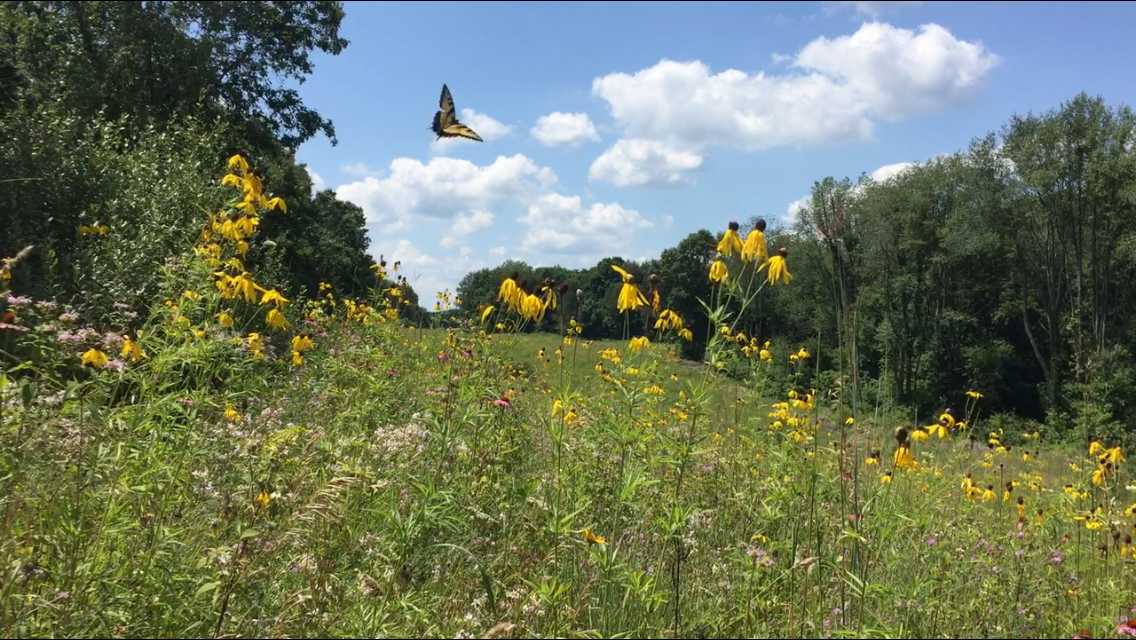
What is it about a video with not much happening but some grass moving in the breeze and a few bird songs that captures me, that centers me, that nourishes me? I’m not certain, but creating what I’ve been calling #QuietVideo is becoming an important contemplative practice.
Living in the pastoral setting of the woods and fields of southwest Michigan, as well as the particular beauty of the Hermitage retreat center where I work, I have plenty opportunities to partake of interesting and beautiful scenes.
I’ve taken plenty of pictures here, as well as done a few audio recordings of forest sounds, recently video has become the format that has captured my attention.
While taking still pictures can be a very valuable contemplative activity, what I’ve discovered in doing video is it forces me to stand and wait in real-time as the video is captured. I can’t just click and move on to the next shot, but I must stand there, quietly for as long as I want the shot to be. Experiencing time in place seems to be one of the critical experiences of creating video. And then, when I’m back home viewing my work, I must put in the same amount of time viewing the shots.
I started this project shooting 30 second clips. That felt like a long time to just stand there as nothing happened. I’ve moved up to 60 second clips. As I’m mostly shooting very still scenes with very little movement in the video, I feel like a minute is good length. If I had a little bit of action, or really good audio I’d consider going longer.
My tool for this contemplative practice is an older iPhone, with very little memory. I was out shooting this weekend and after 7 minutes my memory was full. This is far from ideal and naturally I covet a better camera and more memory but working within your limits can be a good practice as well. At times I will also use a hand-held audio recorder which records in stereo, and where I can also block out wind noise. So far, I’ve been very happy with doing single, still shots, so a sturdy tripod was a great investment.
A critical thing that video includes that isn’t present in photography is audio. (Fully silent video is an option, but not one that interests me at this point.) I’m very happy when a good image can be matched with good audio. I’m certain it is my affinity for and sensitivity to sound that has drawn me to working with video.
I’ve had a couple videos with bad or inconsequential audio, mostly due to wind rumble, and I’ve tried out created a soundtrack with me playing guitar. I’m not sure I’m as pleased with these as with the videos with the “natural” audio but it’s been a helpful learning experience.
I am very aware that I have very little critical knowledge with which to assess the things I am creating. I am not a cinephile, or trained in any artistic medium (excepting a year of guitar lessons). I have some awareness of design and some knowledge of my iPhone camera’s capabilities, but by and large I strive to work on awareness and instinct. Keeping my eyes and ears open and recording scenes that intrigue me even if I don’t exactly know why.
On one level I know I’m a hack just pointing my cheap phone at stuff but there is something about the experience of recording, and reviewing that makes me feel more present, more centered. It would be wonderful if I made videos that were by some critical measure “good”, but their real purpose is personal.
I’m aware of books on photography as a contemplative practice, but I’ve not found others who specifically talk about creating video as a contemplative practice. The work of filmmaker Patrick Shen certainly inspires me, and I’ve recently discovered and been fascinated by some of the works of James Benning.
I know that this practice nurtures my soul, and I know that through this practice I am learning of/experiencing God – but I’ve yet to figure out how to put this into words. A big part of what I like about my video creating experience is the complete absence of words. It is my hope that in the creating and viewing I, and others, experience small sparks of revelation, of awareness, of knowing beyond words.
You can find the videos I’m creating on my YouTube channel.